How to Calculate Ribbon Square Meters (m²) from Ribbon Width × Ribbon Length
How to Calculate Ribbon Square Meters (m²) from Ribbon Width × Ribbon Length – Complete Guide
If you work with thermal transfer ribbons, you've probably seen ribbon specifications like:
- 110 mm × 300 m
- 83 mm × 450 m
- 60 mm × 300 m
- 40 mm × 74 m
Most users understand that 110 mm is the ribbon width and 300 m is the ribbon length, but very few know how to calculate the total ribbon surface area in square meters (m²).
Knowing the ribbon area is extremely useful when comparing ribbon prices, calculating printing costs, estimating coating material, and comparing products from different manufacturers.
In this guide, you'll learn the simple formula to calculate ribbon square meters, understand why it matters, and see practical examples for the most common thermal transfer ribbon sizes.
What Does "110 mm × 300 m" Mean?
Every thermal transfer ribbon has two main dimensions:
- Width – measured in millimeters (mm)
- Length – measured in meters (m)
Example:
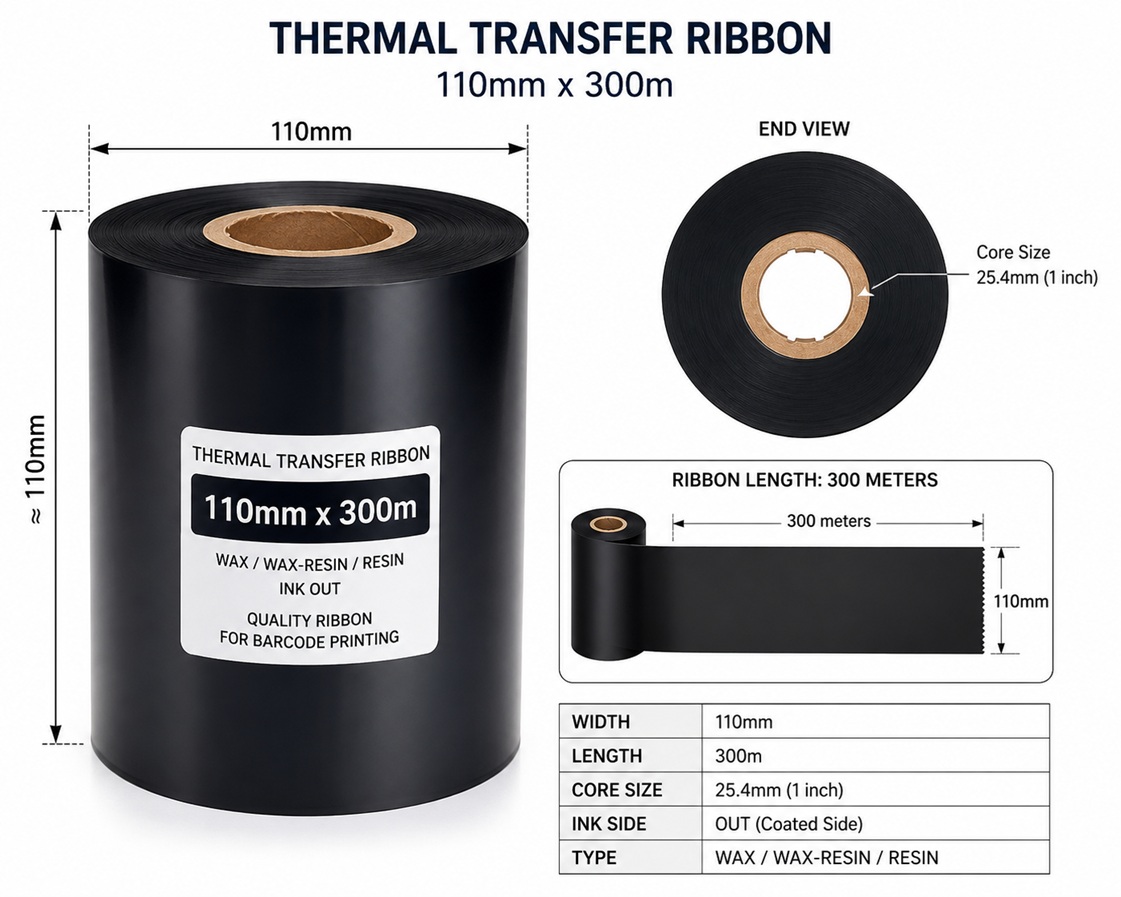
110 mm × 300 m
means:
- Ribbon Width = 110 millimeters
- Ribbon Length = 300 meters
Think of the ribbon as a long strip of film. If you unroll it completely and lay it flat, the total covered area is measured in square meters (m²).
What Is a Square Meter (m²)?
A square meter is a unit of area.
Imagine a square that measures:
1 meter × 1 meter
That equals:
1 m²
When calculating ribbon area, we are determining how much coated film is actually on the ribbon roll.
Why Calculate Ribbon Area?
Knowing the ribbon area provides several advantages:
- Compare ribbon value from different suppliers.
- Calculate cost per square meter.
- Estimate coating material usage.
- Compare ribbons with different widths.
- Manage inventory more accurately.
- Calculate production costs.
- Compare OEM and compatible ribbons fairly.
- Estimate raw material consumption.
Many manufacturers sell ribbons of different widths and lengths. Comparing only the price can be misleading, but comparing cost per m² gives a much more accurate picture.
The Formula
The formula is extremely simple.
Formula Using Meters
Area (m²) = Width (m) × Length (m)
Since ribbon width is almost always specified in millimeters, we first convert it to meters.
Practical Formula
Area (m²) = (Width in mm ÷ 1000) × Length in meters
or
Area (m²) = (Width × Length) ÷ 1000
This shortcut works because:
1000 mm = 1 meter
Example 1 – 110 mm × 300 m Ribbon
Width : 110 mm
Convert to meters : 110 ÷ 1000 = 0.110 m
Length : 300 m
Calculation : 0.110 × 300 = 33.00 m²
Result:
110 mm × 300 m ribbon = 33.00 m²
Example 2 – 110 mm × 450 m Ribbon
Calculation : 0.110 × 450 = 49.50 m²
Result:
49.50 square meters
Example 3 – 83 mm × 300 m Ribbon
Calculation : 0.083 × 300 = 24.90 m²
Example 4 – 60 mm × 300 m Ribbon
Calculation : 0.060 × 300 = 18.00 m²
Example 5 – 40 mm × 74 m Ribbon
Calculation : 0.040 × 74 = 2.96 m²
Quick Reference Table
|
Ribbon Size |
Width (m) |
Length |
Area (m²) |
|
40 mm × 74 m |
0.040 |
74 m |
2.96 m² |
|
60 mm × 74 m |
0.060 |
74 m |
4.44 m² |
|
64 mm × 74 m |
0.064 |
74 m |
4.74 m² |
|
83 mm × 300 m |
0.083 |
300 m |
24.90 m² |
|
110 mm × 74 m |
0.110 |
74 m |
8.14 m² |
|
110 mm × 300 m |
0.110 |
300 m |
33.00 m² |
|
110 mm × 450 m |
0.110 |
450 m |
49.50 m² |
|
84 mm × 450 m |
0.084 |
450 m |
37.80 m² |
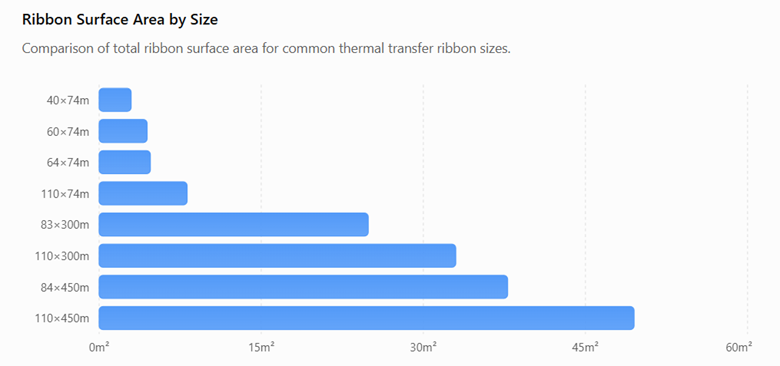
Visual Comparison of Common Ribbon Areas
Ribbon Surface Area by Size
Comparison of total ribbon surface area for common thermal transfer ribbon sizes.
Understanding the Formula
Suppose you have a ribbon : 110 mm × 300 m
Imagine cutting the ribbon and spreading it flat.
Its dimensions become : 0.110 meter × 300 meters
Area equals : 33 square meters
The same principle is used to calculate the area of flooring, carpet, wallpaper, or sheet material.
Does Ribbon Thickness Affect the Area?
No.
Ribbon thickness affects:
- Ribbon weight
- Coating durability
- Ink capacity
- Print quality
It does not affect the square meter calculation.
Only:
- Width
- Length
are used.
Does Ribbon Type Matter?
No.
The same formula applies to:
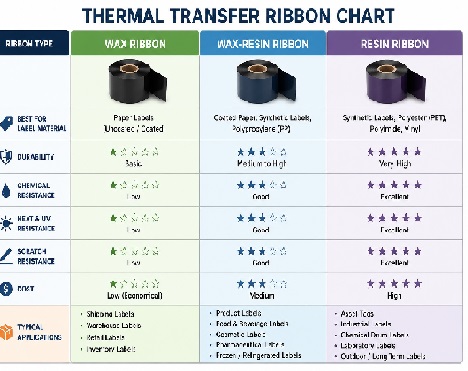
- Wax ribbons
- Wax-resin ribbons
- Resin ribbons
- Near-edge ribbons
- Flat-head ribbons
Area is calculated exactly the same way.
Why Manufacturers Use Width × Length Instead of m²
The ribbon industry has traditionally specified products as:
Width × Length
Examples:
110 mm × 300 m
83 mm × 450 m
60 mm × 300 m
because these dimensions directly indicate printer compatibility. However, converting them into square meters is often useful for comparing products from different suppliers on an equal basis.
Calculating Cost per Square Meter
Suppose:
Ribbon:
110 mm × 300 m
Area : 33.00 m²
Price : KD 6.500
Calculation : 6.500 ÷ 33 =
KD 0.197 per m²
Now compare another ribbon:
Area : 110 × 450 m = 49.5 m²
Price : KD 8.500
Calculation : 8.500 ÷ 49.5 = KD 0.172 per m²
Although the second ribbon costs more overall, it offers a lower cost per square meter, making it a better value.
Common Mistakes
Avoid these common errors:
- Forgetting to convert millimeters into meters.
- Multiplying width in millimeters directly by length in meters without dividing by 1000.
- Confusing square meters (m²) with cubic measurements.
- Assuming ribbon thickness changes the area.
- Comparing ribbons only by price instead of cost per square meter.
Frequently Asked Questions (FAQ)
Why is ribbon width measured in millimeters?
Ribbon widths closely match label widths and printer specifications, making millimeters the standard industry unit.
Can I calculate square meters directly from width in millimeters?
Yes. Use the shortcut formula:
Area (m²) = (Width × Length) ÷ 1000
where the width is in millimeters and the length is in meters.
Does ribbon length affect the calculation?
Yes. Area increases directly with ribbon length. Doubling the ribbon length doubles the total square meters.
Why compare ribbons using square meters?
Comparing ribbons by area allows you to evaluate the true value of different products, calculate the cost per square meter, estimate material usage, and make more informed purchasing decisions.
Final Thoughts
Calculating the square meter (m²) area of a thermal transfer ribbon is simple once you understand the relationship between ribbon width and ribbon length. Whether you're working with a 40 mm × 74 m, 83 mm × 300 m, or 110 mm × 450 m ribbon, the same formula applies:
Area (m²) = (Ribbon Width in mm × Ribbon Length in m) ÷ 1000
This quick calculation provides valuable insights into the total amount of coated ribbon material on a roll, making it easier to compare products, determine cost per square meter, estimate printing expenses, and choose the most economical ribbon for your application. For distributors, manufacturers, and high-volume barcode printing operations, understanding ribbon area is an effective way to improve purchasing decisions, inventory management, and overall production efficiency.