Is PET a Synthetic Label?
Is PET a Synthetic Label?
The short answer is yes.
PET (Polyethylene Terephthalate) is a synthetic label material made from polyester plastic. It is one of the most durable label materials available and is widely used for industrial, laboratory, healthcare, electronics, and outdoor applications.
Unlike ordinary paper labels, PET labels are designed to withstand harsh environments including moisture, chemicals, heat, sunlight, and abrasion.
What Does PET Stand For?
PET stands for:
Polyethylene Terephthalate
It belongs to the polyester family of plastics and is manufactured from petroleum-based raw materials.
Because it is a plastic film instead of paper, PET is classified as a synthetic label material.
What Is a Synthetic Label?
A synthetic label is any label manufactured from plastic film rather than paper.
Common synthetic label materials include:
|
Material |
Full Name |
Typical Uses |
|
PP |
Polypropylene |
Retail, logistics, food |
|
PET |
Polyethylene Terephthalate |
Industrial, asset tracking |
|
PE |
Polyethylene |
Flexible packaging |
|
PVC |
Polyvinyl Chloride |
Outdoor signage |
|
Polyester |
PET |
Durable identification labels |
PET is considered the premium choice among synthetic materials because of its excellent durability.
How PET Labels Are Made
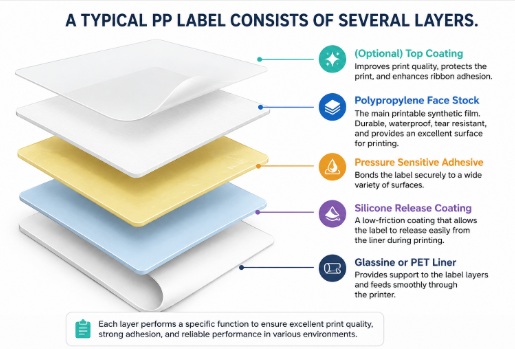
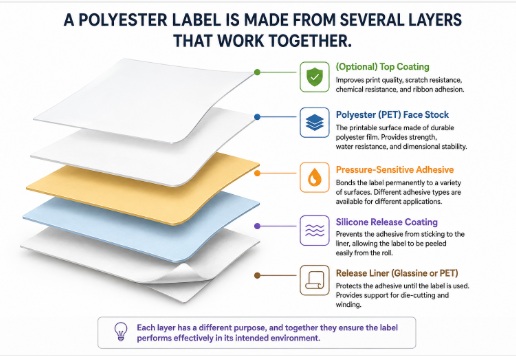
A PET label consists of several layers.
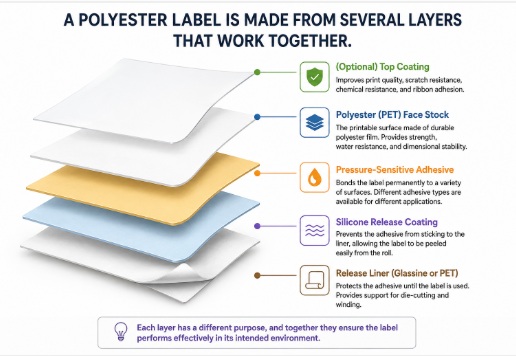
- PET film provides durability.
- The adhesive bonds the label to the surface.
- The silicone layer allows easy release from the liner.
- The liner protects the adhesive until application.
Why PET Labels Are Called Polyester Labels
Many suppliers simply refer to PET labels as Polyester Labels.
This is because PET is a type of polyester plastic.
Therefore, these terms all describe the same material:
- PET Label
- Polyester Label
- Polyester Film Label
- PET Synthetic Label
Characteristics of PET Labels
PET labels offer excellent performance in demanding environments.
Extremely Durable
PET resists:
- Tearing
- Scratching
- Water
- Oils
- Grease
- Chemicals
- UV light
- High temperatures
This makes PET one of the longest-lasting label materials.
Waterproof
Unlike paper labels, PET does not absorb water.
It remains stable even after prolonged exposure to moisture.
Ideal applications include:
- Refrigeration
- Outdoor equipment
- Industrial machinery
- Laboratories
Chemical Resistant
PET performs well when exposed to:
- Alcohol
- Cleaning agents
- Machine oils
- Mild acids
- Industrial solvents (depending on ribbon and adhesive)
For aggressive chemicals, a resin ribbon is typically recommended.
High Temperature Resistance
Typical PET labels withstand temperatures around:
- -40°C to +150°C (depending on manufacturer)
Some specialty PET materials tolerate even higher temperatures.
Excellent Dimensional Stability
PET expands and contracts very little.
This helps maintain:
- Barcode accuracy
- Print quality
- Label positioning
Even after years of use.
PET Label Finishes
PET labels are available in various finishes.
White PET
Most common.
Used for:
- Product identification
- Asset labels
- Barcode labels
Silver PET
Popular for:
- Equipment labels
- Asset tags
- Compliance plates
Silver PET gives a professional metallic appearance.
Clear PET
Ideal when the label should appear almost invisible.
Often used on:
- Glass bottles
- Cosmetic packaging
- Premium products
Matte PET
Provides:
- Lower glare
- Better barcode scanning
- Excellent thermal transfer printing
Gloss PET
Offers:
- Bright appearance
- Premium finish
- Attractive product labeling
Advantages of PET Labels
✔ Waterproof
✔ Tear resistant
✔ Chemical resistant
✔ Heat resistant
✔ Long outdoor life
✔ Excellent barcode quality
✔ Professional appearance
✔ Excellent durability
✔ Available in many colours and finishes
Disadvantages of PET Labels
Like any material, PET also has limitations.
- More expensive than paper
- Higher cost than polypropylene
- Requires thermal transfer printing in most industrial applications
- Usually requires a resin ribbon for maximum durability
- Less flexible than PE film
PET vs Paper Labels
|
Feature |
PET |
Paper |
|
Waterproof |
Excellent |
Poor |
|
Tear Resistance |
Excellent |
Low |
|
Chemical Resistance |
Excellent |
Poor |
|
Outdoor Use |
Excellent |
Limited |
|
Heat Resistance |
Excellent |
Low |
|
Lifespan |
Years |
Months |
PET vs Polypropylene (PP)
|
Feature |
PET |
PP |
|
Durability |
Excellent |
Very Good |
|
Flexibility |
Moderate |
High |
|
Chemical Resistance |
Excellent |
Good |
|
Heat Resistance |
Excellent |
Moderate |
|
Scratch Resistance |
Excellent |
Good |
|
Cost |
Higher |
Lower |
PP is ideal for general-purpose labeling.
PET is preferred for harsh environments.
Which Ribbon Should Be Used?
PET labels are almost always printed using thermal transfer printers.
Recommended ribbon types:
|
Ribbon |
Suitable |
|
Wax |
✗ Not Recommended |
|
Wax-Resin |
✓ Light industrial use |
|
Resin |
★ Best Choice |
Resin ribbons provide:
- Maximum durability
- Chemical resistance
- Scratch resistance
- Waterproof printing
Common Applications
PET labels are widely used for:
- Asset management
- Equipment identification
- Laboratory labels
- Electronics
- PCB labels
- Medical devices
- Electrical panels
- Rating plates
- Industrial machinery
- Outdoor equipment
- Chemical containers
- Automotive parts
- Cable identification
- Compliance labels
Can PET Labels Be Used Outdoors?
Yes.
PET labels perform exceptionally well outdoors because they resist:
- Rain
- UV exposure
- Heat
- Cold
- Humidity
When paired with a high-quality adhesive and resin ribbon, PET labels can last for many years in outdoor environments.
Are PET Labels Waterproof?
Yes.
PET film itself is waterproof.
However, the overall durability also depends on:
- The adhesive
- The printing ribbon
- The printer settings
- Environmental conditions
Frequently Asked Questions
Is PET considered a synthetic label?
Yes. PET is a polyester plastic film and is classified as a synthetic label material.
Is PET stronger than polypropylene?
Generally, yes. PET offers better heat resistance, scratch resistance, and chemical resistance than PP, although PP is more flexible.
Can PET labels be printed with direct thermal printers?
No. Standard PET labels are not direct thermal. They are designed for thermal transfer printing, typically with wax-resin or resin ribbons.
Are PET labels waterproof?
Yes. PET film is naturally waterproof and suitable for wet environments.
Can PET labels be used for barcodes?
Absolutely. PET provides excellent dimensional stability and produces high-quality, durable barcodes when printed with the appropriate ribbon.
Conclusion
PET (Polyethylene Terephthalate) is one of the most durable synthetic label materials available. Compared with paper labels, it offers superior resistance to water, chemicals, heat, UV exposure, and physical wear, making it ideal for demanding industrial and outdoor applications.
While PET labels typically cost more than polypropylene or paper labels, their long service life and excellent print durability often make them the most cost-effective choice for asset identification, equipment labeling, electronics, healthcare, and compliance labeling.