What Is a 2D Data Matrix Barcode? Complete Guide
What Is a Data Matrix Barcode?
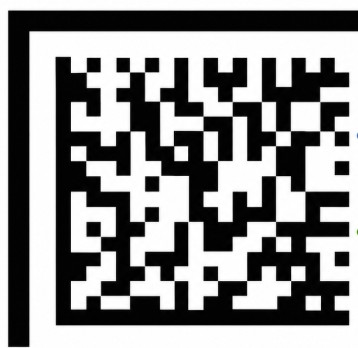
A Data Matrix barcode is a two-dimensional (2D) barcode that stores information using tiny black and white square modules arranged in a square or rectangular grid.
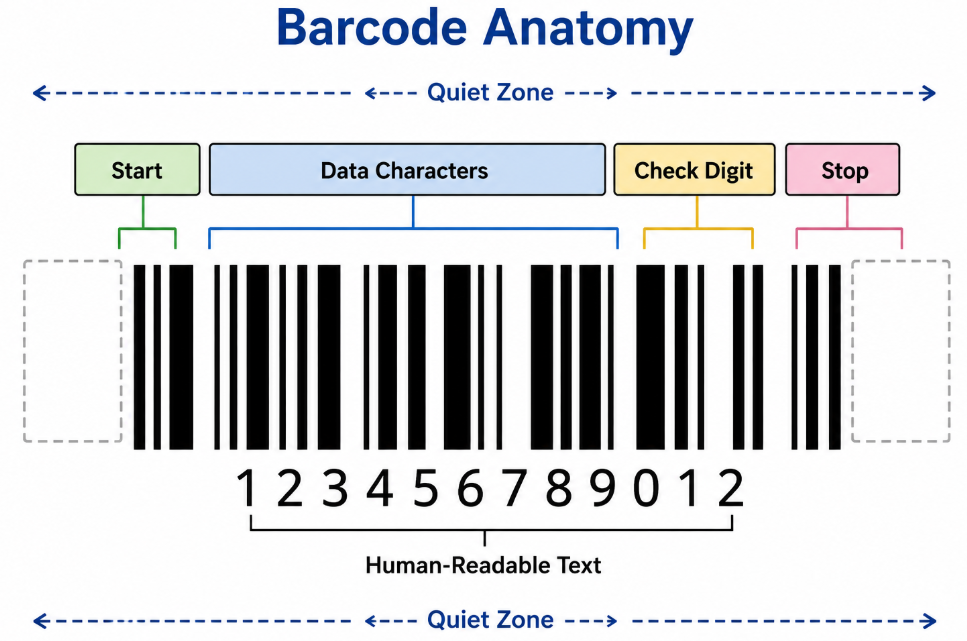
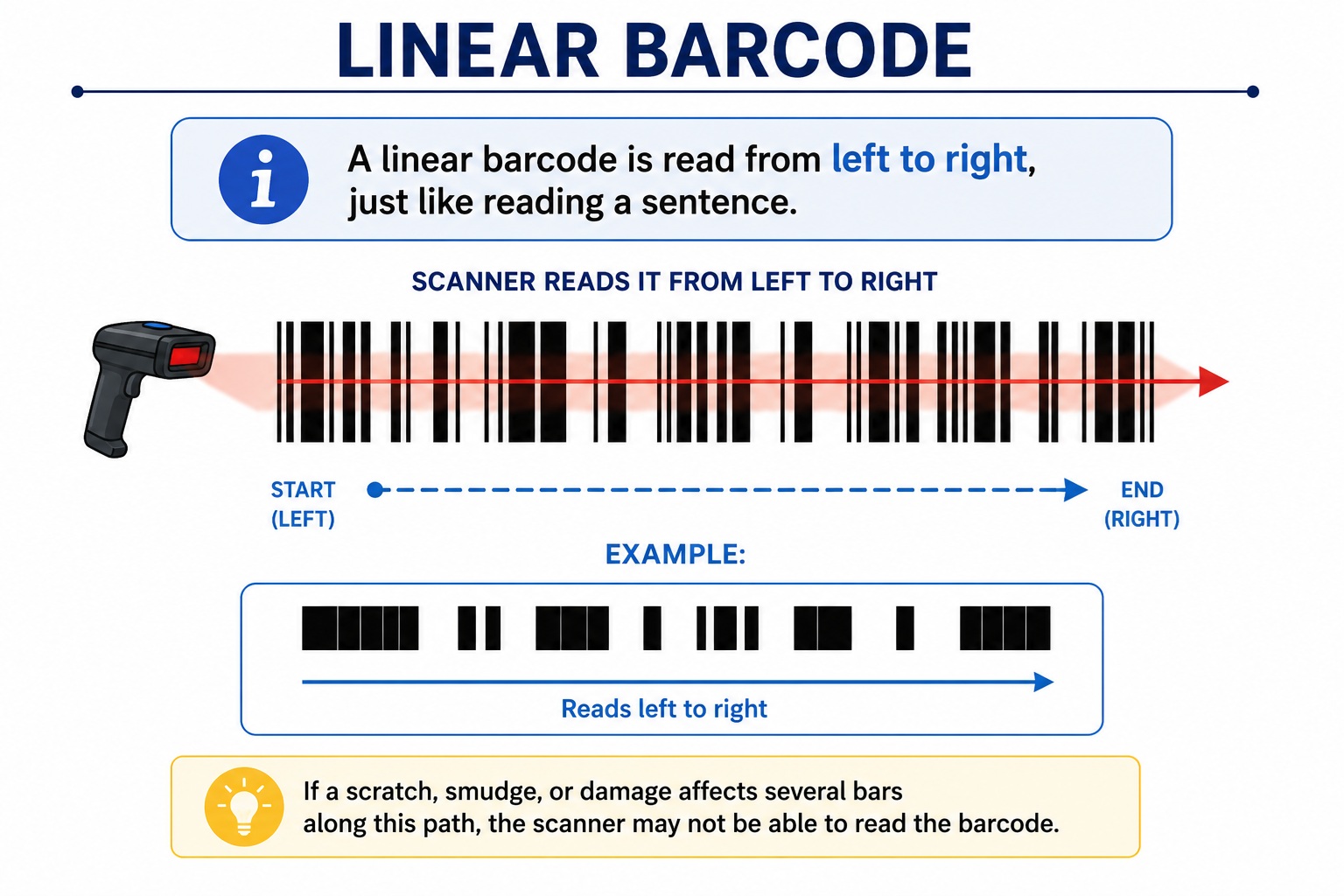
Unlike traditional 1D (linear) barcodes, which store data in a single horizontal direction, a Data Matrix stores data both horizontally and vertically, allowing it to hold significantly more information in a much smaller space.
Because of its compact size, high reliability, and excellent damage tolerance, the Data Matrix barcode has become the preferred choice for industries such as healthcare, electronics, aerospace, automotive manufacturing, and direct part marking (DPM).
What Does a Data Matrix Barcode Look Like?
A Data Matrix barcode is made up of:
- Small black and white square cells (modules)
- A solid L-shaped border called the Finder Pattern
- Alternating timing pattern on the other two sides
- Encoded data inside the grid
Unlike QR Codes, a Data Matrix does not have the three large corner squares.
Illustration
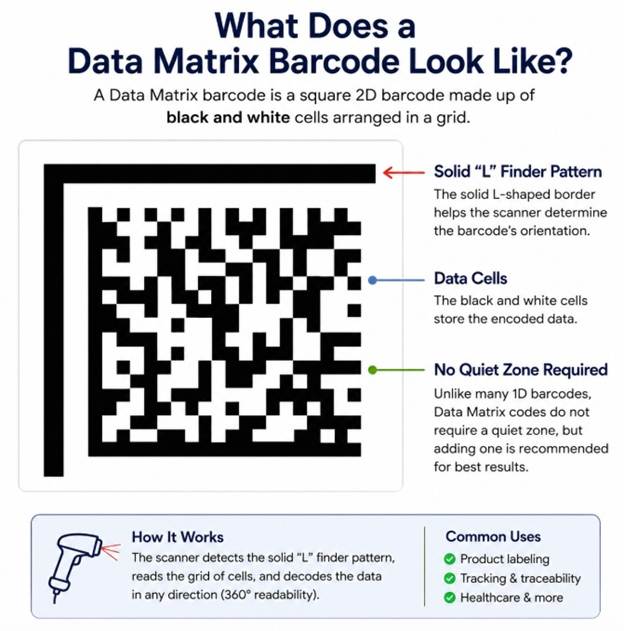
The solid "L" border helps the scanner determine the barcode's orientation.
How Does a Data Matrix Barcode Work?
A Data Matrix barcode works by converting text, numbers, or binary data into a pattern of tiny square modules.
The process is simple:
Step 1 – Encode Data
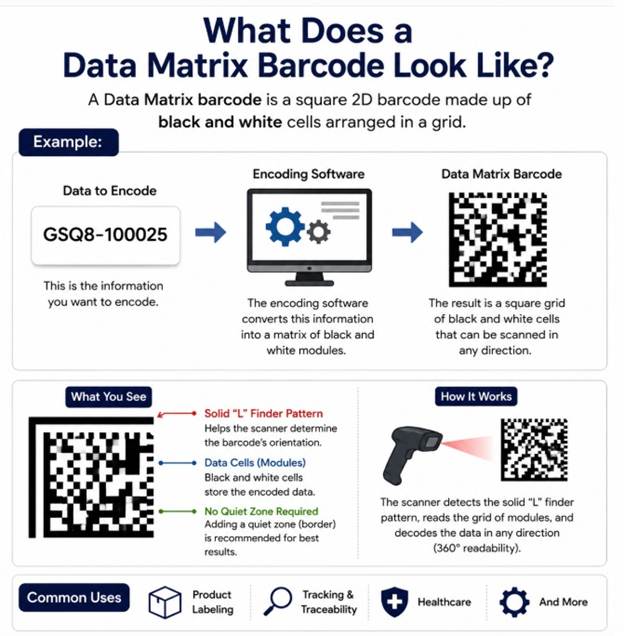
The encoding software converts this information into a matrix of black and white modules.
Step 2 – Print or Mark
The barcode can be:
- Printed on labels
- Laser engraved
- Dot peened
- Chemically etched
- Inkjet printed
- Directly marked onto metal or plastic parts
Step 3 – Scan
A 2D imaging scanner or camera captures the entire symbol.
Unlike laser scanners, imaging scanners read the complete barcode at once.
Step 4 – Decode
The software reconstructs the original information, even if part of the symbol is damaged.
Why Is Data Matrix So Popular?
Data Matrix offers several major advantages over traditional linear barcodes.
Extremely Small
A Data Matrix can remain readable even when printed just a few millimetres wide.
This makes it ideal for:
- Electronic components
- Surgical instruments
- Jewelry
- Small product labels
- Medical devices
Stores Much More Information
Compared to a 1D barcode, a Data Matrix stores significantly more data.
It can encode:
- Serial numbers
- Product IDs
- Batch numbers
- Manufacturing dates
- URLs
- Binary data
- GS1 Application Identifiers (AIs)
Excellent Error Correction
Modern Data Matrix barcodes use ECC200 Reed-Solomon error correction.
This means the scanner can often reconstruct the data even if part of the barcode is:
- Scratched
- Dirty
- Worn
- Partially missing
This is one of the biggest reasons Data Matrix is trusted in industrial environments.
Data Capacity
The maximum capacity depends on the symbol size and data type.
Approximate limits:
|
Data Type |
Maximum Capacity |
|
Numeric |
Up to 3,116 digits |
|
Alphanumeric |
Up to 2,335 characters |
|
Binary |
Up to 1,556 bytes |
In most practical applications, far less data is used to keep the symbol compact and easy to scan.
Common Applications
Healthcare
Data Matrix is widely used for:
- Medicine packaging
- Medical devices
- Surgical instruments
- Laboratory samples
- Patient identification
Many healthcare regulations require Data Matrix codes for product traceability.
Electronics
Used on:
- Printed circuit boards (PCBs)
- Semiconductors
- Mobile phone components
- Microchips
The barcode can be extremely small while remaining readable.
Automotive
Manufacturers permanently mark:
- Engine parts
- Gearboxes
- Chassis components
- Safety-critical parts
This enables lifetime traceability.
Aerospace
Aircraft manufacturers use Data Matrix codes for:
- Component identification
- Maintenance records
- Spare parts tracking
Manufacturing
Common uses include:
- Work-in-progress tracking
- Production traceability
- Asset identification
- Tool management
Direct Part Marking (DPM)
One of the biggest strengths of Data Matrix is Direct Part Marking (DPM).
Instead of using adhesive labels, the barcode is permanently marked directly onto the product.
Methods include:
- Laser engraving
- Dot peening
- Chemical etching
- Electrochemical marking
Even after years of use, the barcode remains readable.
Finder Pattern
One unique feature of Data Matrix is its Finder Pattern.
It consists of:
- Two solid black borders forming an "L"
- Two alternating black and white borders
The scanner uses these patterns to:
- Locate the barcode
- Determine rotation
- Identify the module grid
- Decode accurately
Error Correction (ECC200)
Older versions of Data Matrix used different error correction methods.
Today, almost all Data Matrix symbols use ECC200, which provides:
- Higher reliability
- Better damage recovery
- Improved decoding speed
- Industry-standard compatibility
Because of ECC200, a Data Matrix symbol can often be read even when a noticeable portion is damaged.
Data Matrix vs QR Code
|
Feature |
Data Matrix |
QR Code |
|
Shape |
Square or rectangular |
Mostly square |
|
Finder Pattern |
Solid "L" border |
Three large corner squares |
|
Typical Size |
Very small |
Medium to large |
|
Error Correction |
ECC200 |
Reed-Solomon (multiple levels) |
|
Best For |
Industrial marking, healthcare |
Marketing, websites, payments |
|
Direct Part Marking |
Excellent |
Less common |
|
Small Components |
Excellent |
Good |
Data Matrix vs 1D Barcode
|
Feature |
1D Barcode |
Data Matrix |
|
Data Direction |
Horizontal only |
Horizontal and vertical |
|
Data Capacity |
Low |
Very high |
|
Physical Size |
Larger |
Very compact |
|
Damage Resistance |
Limited |
Excellent |
|
Scanner |
Laser or imager |
Imaging scanner only |
|
Traceability |
Good |
Excellent |
Best Practices for Printing Data Matrix Codes
To achieve reliable scanning:
- Maintain high print or marking quality.
- Preserve the required quiet zone (clear margin) around the symbol.
- Avoid excessive distortion or stretching.
- Use sufficient contrast between dark and light areas.
- Match the symbol size to the scanner's capabilities.
- Verify symbols using barcode verification equipment where required.
Advantages
✔ Stores large amounts of information
✔ Very compact
✔ Excellent damage tolerance
✔ Supports Direct Part Marking
✔ Ideal for harsh industrial environments
✔ Widely accepted in healthcare and manufacturing
✔ High reliability with ECC200 error correction
Limitations
- Requires a 2D imaging scanner or camera (laser scanners cannot decode Data Matrix symbols).
- Very small symbols require good print quality and proper scanner resolution.
- More complex to generate than basic 1D barcodes.
Frequently Asked Questions (FAQ)
Is Data Matrix the same as a QR Code?
No. Both are 2D barcodes, but they use different patterns, capacities, and are optimized for different applications. Data Matrix is especially popular for industrial and healthcare use.
Can a smartphone read a Data Matrix barcode?
Yes. Many smartphone apps and some built-in camera software can decode Data Matrix symbols, although dedicated industrial imagers provide better performance.
Why do manufacturers prefer Data Matrix?
Because it can encode more information in a much smaller space and remains readable even after permanent marking or partial damage.
Can a laser scanner read a Data Matrix code?
No. Data Matrix requires a 2D imaging scanner or camera-based reader. Traditional laser barcode scanners are designed for 1D barcodes only.
Does a Data Matrix barcode need a quiet zone?
Yes. Like all barcodes, a Data Matrix requires a clear, blank margin around the symbol to help scanners locate and decode it reliably.
Final Thoughts
The Data Matrix barcode is one of the most efficient and reliable barcode technologies available today. Its ability to store large amounts of information in a tiny space, combined with strong ECC200 error correction and support for direct part marking, makes it the preferred solution for industries where accuracy and traceability are essential.
Whether you're labeling electronic components, medical devices, automotive parts, or industrial equipment, Data Matrix provides exceptional performance in environments where traditional barcodes may not be sufficient.