A Complete Guide to Environmental Damage and Material Selection
Shielding Your Labels: A Complete Guide to Environmental Damage and Material Selection
If you operate in manufacturing, logistics, chemical processing, or outdoor asset management, your labels do a lot of heavy lifting. They carry critical barcodes, tracking numbers, safety warnings, and compliance data. When a label degrades, peels, or fades into illegibility, your entire data chain breaks down.
While indoor office labels face minimal stress, industrial labels are constantly at war with their surroundings. Environmental factors like extreme temperatures, moisture, and chemical exposure can completely destroy standard paper labels in a matter of hours.
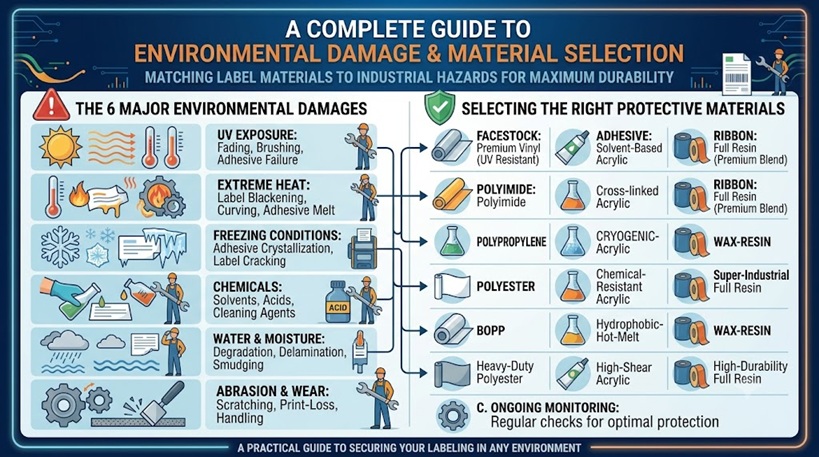
To keep your operations running smoothly, you need to match your labeling materials to the specific hazards of your environment. This guide breaks down the six major types of environmental damage and provides a roadmap for selecting the perfect material combinations to survive them.
1. Heat
High temperatures are a major threat to industrial labels, especially in automotive manufacturing, electronics processing (such as circuit board soldering), and heavy industrial machinery environments.
The Damage
Excessive heat breaks down standard label adhesives, causing them to dry out, lose tack, and completely peel away from the surface. For direct thermal labels, ambient heat or high-intensity friction turns the chemical coating entirely black, erasing barcodes and text instantly.
Material Recommendations
When things heat up, you need specialized synthetics that can handle the thermal load:
- Facestock: Polyimide (Kapton) is the gold standard for extreme heat, capable of surviving temperatures up to 300°C (572°F). For moderate high-heat applications, Polyester (PET) provides excellent stability up to 150°C (302°F).
- Adhesive: High-temperature, cross-linked acrylic adhesives are required to ensure the label won't slide or flag under thermal stress.
- Ribbon: Always pair heat-resistant facestocks with a full resin ribbon via thermal transfer printing to ensure the ink itself doesn't melt or bleed.
2. UV Exposure
Outdoor assets-such as chemical drums, utility poles, construction equipment, and warehouse yard racks-face constant exposure to the sun.
The Damage
Ultraviolet (UV) radiation breaks down the chemical bonds in both standard inks and base materials. Over time, UV rays cause colored text to fade, white labels to turn yellow and brittle, and standard thermal transfer ink to vanish completely, leaving a blank, unscannable tag.
Material Recommendations
Outdoor longevity requires materials engineered with UV inhibitors:
- Facestock: Premium Matte Polyester or specialized Vinyl (PVC). Vinyl is exceptionally flexible and naturally resilient against UV degradation, making it ideal for curved outdoor surfaces.
- Adhesive: Solvent-based acrylic adhesives offer the best long-term weatherability and UV resistance, preventing the glue from becoming brittle.
- Ribbon: A high-end resin or premium wax/resin blend designed specifically for outdoor durability. For maximum protection, a clear UV-blocking laminate over-lamination can be applied over the printed label.
3. Chemicals
From laboratory test tubes to industrial manufacturing floors, labels frequently come into contact with aggressive solvents, cleaning agents, and fuels.
The Damage
Chemical exposure can instantly dissolve standard water-based adhesives or wipe away standard wax inks like water on a chalkboard. Harsh chemicals like acetone, isopropyl alcohol (IPA), brake fluid, and industrial degreasers can smear, melt, or entirely strip the printed image from the facestock.
Material Recommendations
Surviving chemical contact requires a completely inert, non-reactive label construction:
- Facestock: Polyester (PET) or Polypropylene (PP). Polyester offers the highest level of chemical resistance against aggressive industrial solvents.
- Adhesive: Specialized chemical-resistant acrylic adhesives engineered to maintain their bond even when submerged or splashed with fluids.
- Ribbon: Standard ribbons will fail immediately here. You must use a super-industrial full resin ribbon. The high melting point of the resin fuses completely with the polyester facestock, creating a virtually indestructible, chemical-proof bond.
4. Water and Moisture
Moisture damage isn't limited to outdoor rain. It includes high-humidity warehouses, cold-storage condensation, food processing washdowns, and marine shipping environments.
The Damage
Moisture is fatal to standard paper labels. Water causes paper fibers to swell, wrinkle, and weaken, leading to structural tearing. Standard water-based adhesives will emulsify, turning into a milky, slippery residue that slides right off the product.
Material Recommendations
When water is present, you must eliminate paper entirely and switch to a 100% waterproof synthetic barrier:
- Facestock: Polypropylene (BOPP) or Polyethylene (PE). Polyethylene is highly flexible and conforms beautifully to squeezable bottles or irregular containers, while Polypropylene provides a rigid, crystal-clear, or bright white waterproof shield.
- Adhesive: Rubber-based hot melt adhesives or solvent acrylics. These adhesives are naturally hydrophobic, ensuring they grip tightly to wet or damp surfaces without breaking down.
- Ribbon: A durable wax/resin or full resin ribbon ensures the text won't smudge or fade when exposed to high-pressure washdowns or marine salt spray.
5. Abrasion
Labels on conveyor belts, shipping pallets, asset tags on tools, and warehouse floor markers face constant physical friction, scraping, and handling.
The Damage
Mechanical abrasion physically grinds the printed ink off the surface of the label. Over time, constant scraping scuffs the facestock, blurs the edges of barcodes, and renders them unreadable by optical scanners.
Material Recommendations
Beating abrasion requires physical hardness and surface protection:
- Facestock: Heavy-duty Polyester (PET) or thick Vinyl. For extreme abrasion (like warehouse floor labeling), a thick, clear polycarbonate or polyester laminate layer must be applied over the printing.
- Adhesive: High-shear acrylic adhesives that prevent the label from shifting or tearing away at the corners when scraped.
- Ribbon: A high-durability full resin ribbon is mandatory. The resin creates a hard, scratch-resistant plastic layer over the label text that withstands rigorous physical rubbing and handling.
6. Freezing Conditions
Cold-storage logistics, deep-freeze food packaging, and outdoor winter environments present unique challenges that standard labels cannot handle.
The Damage
When standard labels are applied in freezing temperatures, the adhesive freezes instantly into a hard, glassy solid before it can flow into the microscopic pores of the surface. This results in immediate label drop-off. Furthermore, frost and condensation build-up can ruin the facestock when the product thaws.
Material Recommendations
Cold environments require specialized chemistry designed to remain flexible in sub-zero temperatures:
- Facestock: Polypropylene or specialized cryogenic frost-resistant papers. Polypropylene remains flexible and structurally sound without cracking in deep-freeze environments.
- Adhesive: All-temperature or "Deep Freeze" acrylic adhesives. These formulas are uniquely engineered to be applied at temperatures as low as -25°C (-13°F) and maintain their bond all the way down to -50°C (-58°F) without becoming brittle.
- Ribbon: A wax/resin ribbon provides excellent scratch and smudge resistance against frost and handling in cold storage lines.
Quick Reference Material Selection Matrix
|
Environment |
Primary Hazard |
Recommended Facestock |
Recommended Adhesive |
Recommended Ribbon Type |
|
Heat |
Adhesive melting, blackening |
Polyimide (Kapton) / Polyester |
High-Temp Acrylic |
Full Resin |
|
UV Exposure |
Fading, yellowing, brittleness |
Vinyl (PVC) / UV Polyester |
Solvent Acrylic |
Premium Resin + Laminate |
|
Chemicals |
Ink smearing, label dissolution |
Polyester (PET) |
Chemical-Resistant Acrylic |
Industrial Full Resin |
|
Water / Moisture |
Tearing, adhesive emulsification |
Polypropylene (BOPP) / PE |
Rubber-Based Hot Melt |
Wax/Resin or Resin |
|
Abrasion |
Physical scraping, fading |
Heavy-Duty Polyester |
High-Shear Acrylic |
High-Durability Resin |
|
Freezing |
Adhesive crystallization |
Polypropylene / Cryo-Paper |
Deep-Freeze Acrylic |
Wax/Resin |
Conclusion: Test Before You Deploy
Selecting the right industrial labeling materials is an investment in your operational accuracy. Using a cheap paper label in a harsh chemical or high-heat environment might save a few cents initially, but the cost of lost inventory, missed shipments, and re-labeling labor is astronomical.
Before ordering materials on a scale, always request sample rolls to test in your actual environment. Run them through your specific thermal transfer printers, subject them to your facility's environmental extremes, and verify their readability with your scanners. Taking the time to properly match your facestock, adhesive, and ribbon to your unique environmental challenges ensures your data stays intact-no matter what you throw at it.
Which environmental factor causes the most labelling headaches in your facility? Reach out to discover our custom-matched industrial media solutions designed to survive the toughest conditions.