The Definitive Industrial Guide to Thermal Transfer Ribbons
The Definitive Industrial Guide to Thermal Transfer Ribbons: Formulations, Specifications, and Substrate Engineering
In automated data capture, barcode systems, and industrial product identification, your choice of printing consumables dictates long-term workflow reliability, asset traceability, and operating overheads. While direct thermal printing is adequate for short-term applications with low environmental exposure, Thermal Transfer Printing remains the undisputed global standard for durable, high-density, and permanent labeling requirements.
The technical cornerstone of this process is the thermal transfer ribbon: a micro-engineered polyester carrier film coated with specialized, heat-sensitive chemical ink formulations. Under the concentrated thermal energy of a digital printhead, these inks melt and bond instantly with a label face stock. Selecting an incorrect formulation or an unoptimized ribbon-to-label pairing can result in structural print degradation, unscannable barcodes, premature printhead failure, or high material waste.
1. Anatomy of a Thermal Transfer Ribbon
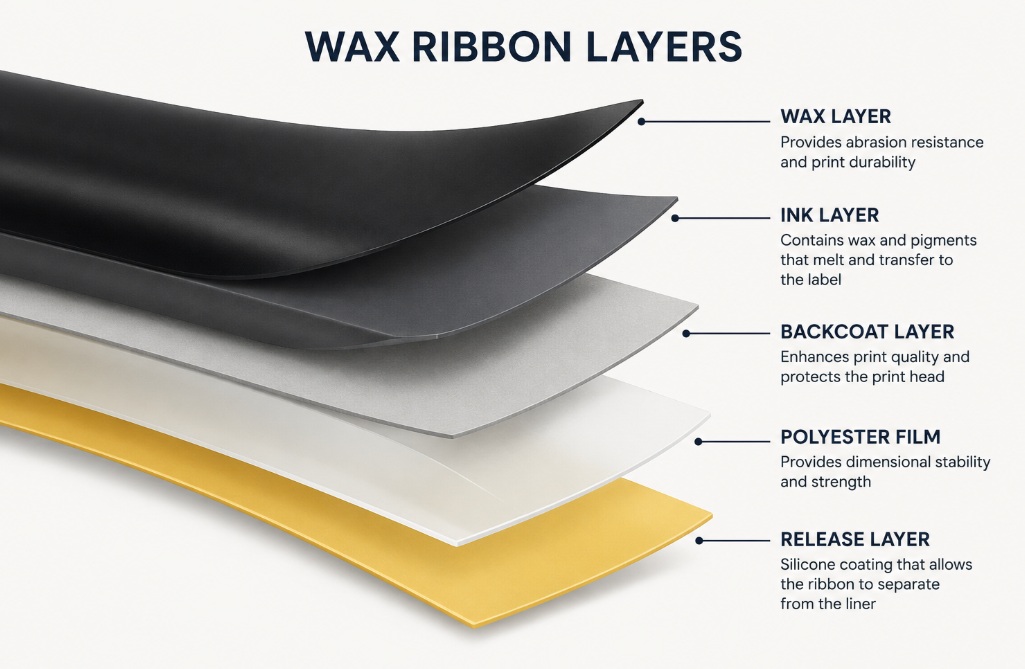
A professional-grade thermal transfer ribbon is not a simple film coated with ink. It is a multi-layered component engineered to protect printer hardware while ensuring flawless ink transfer at high production speeds.
- The Backcoating Layer: This is arguably the most critical layer for printer maintenance. It consists of a silicone-based coefficient-of-friction reducing agent. It allows the polyester film to slide smoothly across the delicate heating elements of the printhead, dissipating static electricity (ESD) and preventing abrasive wear.
- The PET Base Film: Acting as the structural carrier, this layer is typically made of a ultra-thin, highly uniform polyester film (commonly 4.5 micrometers in thickness) capable of withholding intense localized heat without warping or tearing.
- The Primer and Ink Layers: The primer ensures the ink adheres tightly to the PET carrier during storage but releases instantly when heated. The ink layer itself contains the proprietary blend of waxes, resins, and carbon black pigments that form your printed image.
2. In-Depth Chemical Breakdown of Ribbon Formulations
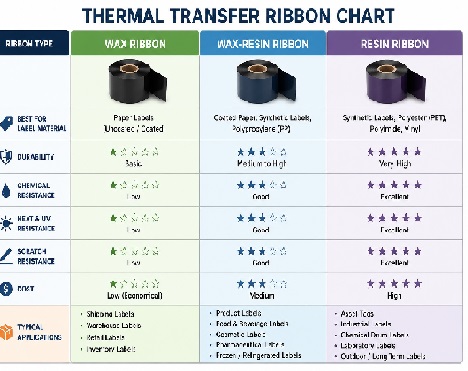
Thermal transfer ribbons are categorized into three core chemical groups based on their compound matrix: wax, wax-resin, and pure resin. Each group features distinct performance tiers to accommodate specific requirements.
A. Regular (Standard) Wax Ribbons
Regular wax ribbons represent the most cost-effective consumable tier in the thermal imaging market. The ink layer is composed predominantly of paraffin and carnauba-based waxes. Because these components possess a low melting point, they require very little thermal energy from the printhead to liquefy.
- Key Performance Indicators: Lowest printhead temperature settings (preserving printhead life) and excellent optical density (deep, dark blacks) at high printing speeds on matte stocks.
- Target Substrates: Uncoated paper labels, standard vellum, and basic matte paper tags.
- Industrial Weaknesses: Zero chemical resistance and low mechanical abrasion tolerance. The printed image can easily smudge or scratch off under normal handling or friction.
B. Premium Wax Ribbons
Premium wax formulations introduce a fractional percentage of synthetic resin modifiers into the traditional wax base. This structural change alters the polymer cross-linking during the melting phase.
- Key Performance Indicators: Noticeably improved scratch resistance compared to regular wax. It produces crisper, more defined edges on high-density linear codes and small 2D DataMatrix barcodes.
- Target Substrates: Semi-gloss coated papers, premium chromo papers, machine-coated tag stocks, and high-quality shipping labels.
- Industrial Weaknesses: While it survives basic handling much better than regular wax, it remains vulnerable to water immersion, oils, solvents, and heavy outdoor weathering.
C. Standard Wax-Resin Ribbons
Wax-resin ribbons are engineered by compounding high-grade petroleum waxes with advanced synthetic acrylic or polyurethane resins in relatively balanced ratios. This formulation bridges the gap between economical paper printing and ultra-durable synthetic films.
- Key Performance Indicators: Outstanding resistance to mechanical abrasion, scratching, and moderate scuffing. It offers dependable protection against moisture, humidity, and mild household or industrial cleaning chemicals.
- Target Substrates: Coated gloss papers, premium clay-coated stocks, polypropylene (PP), polyethylene (PE), and generic synthetic films.
D. Regular Resin Ribbons
Regular resin ribbons discard the wax component completely. The ink matrix is constructed out of pure synthetic polymers that require high thermal energy to melt and fuse securely onto a synthetic substrate.
- Key Performance Indicators: High smudge and scratch resistance. Complete moisture barrier immunity and stable performance when exposed to gasoline, alcohol, engine oils, and commercial detergents.
- Target Substrates: Synthetic films, high-density polypropylene (PP), polyethylene (PE), and basic vinyl surfaces.
E. Premium / Industrial Resin Ribbons
Premium resin ribbons represent the absolute pinnacle of thermal transfer chemical engineering, specifically designed to survive in extreme industrial, automotive, and aerospace environments.
- Key Performance Indicators: Total immunity to harsh industrial solvents, including acetone, xylene, brake fluid, toluene, and aviation fuels. They feature an extreme temperature tolerance profile, surviving in conditions ranging from cryogenic deep-freeze storage ($-196^\circ\text{C}$) up to ultra-high industrial oven environments ($+300^\circ\text{C}$) without losing barcode readability or adhesion.
- Target Substrates: Matte or gloss specialized polyester (PET), polyimide (Kapton) films, chemical drum labels, and rating plates.
3. Ribbon Types Quick-Reference Matrix
|
Ribbon Type |
Printhead Temperature |
Scratch Resistance |
Chemical Resistance |
Primary Substrates |
|
Regular Wax |
Low |
Low |
None |
Vellum, Uncoated Paper Stock |
|
Premium Wax |
Low to Medium |
Moderate |
Very Low |
Semi-Gloss, Coated Chromo Paper |
|
Wax-Resin |
Medium |
High |
Moderate |
Gloss Paper, Polypropylene, PE |
|
Regular Resin |
High |
Excellent |
High |
Polypropylene, Polyethylene, Vinyl |
|
Premium Resin |
Very High |
Extreme |
Extreme (Solvents) |
Polyester (PET), Polyimide, Matte Film |
4. Mechanical Dynamics: Flat-Head vs. Near-Edge Printheads
A common point of operational failure is purchasing a ribbon designed for a printer mechanical configuration that does not match your hardware. The thermal transfer industry utilizes two completely different printhead structural layouts:
Flat-Head Technology
In a flat-head printer (e.g., standard Zebra, Honeywell, TSC desktop and industrial models), the printhead sits entirely flat against the ribbon and label web. The heating elements are located in the center of the printhead assembly. The ribbon remains in physical contact with the label substrate for a short distance after passing the heating zone before being peeled away.
- Ribbon Requirement: Standard flat-head ribbons formulation (slower, more controlled wax/resin melting action).
Near-Edge / Corner-Edge Technology
In a near-edge printer (e.g., specialized Toshiba TEC or Avery Dennison industrial machines), the printhead is angled. The heating elements are positioned right at the extreme edge of the assembly. The ribbon and label substrate separate instantly-milliseconds after being heated. This allows for incredibly fast print speeds (up to 12+ inches per second).
- Ribbon Requirement: Specialized Near-Edge Ribbons. These contain a highly modified release layer that flashes fluidly and instantly releases the ink from the PET film. Running a flat-head ribbon in a near-edge printer will cause severe structural smudging or zero ink transfer.
5. Core Formats, Width Configurations, and Dimensions
Ribbon core compatibility depends entirely on the physical size and classification of your target thermal printer. Selecting the correct core prevents mechanical slip or alignment faults during production runs.
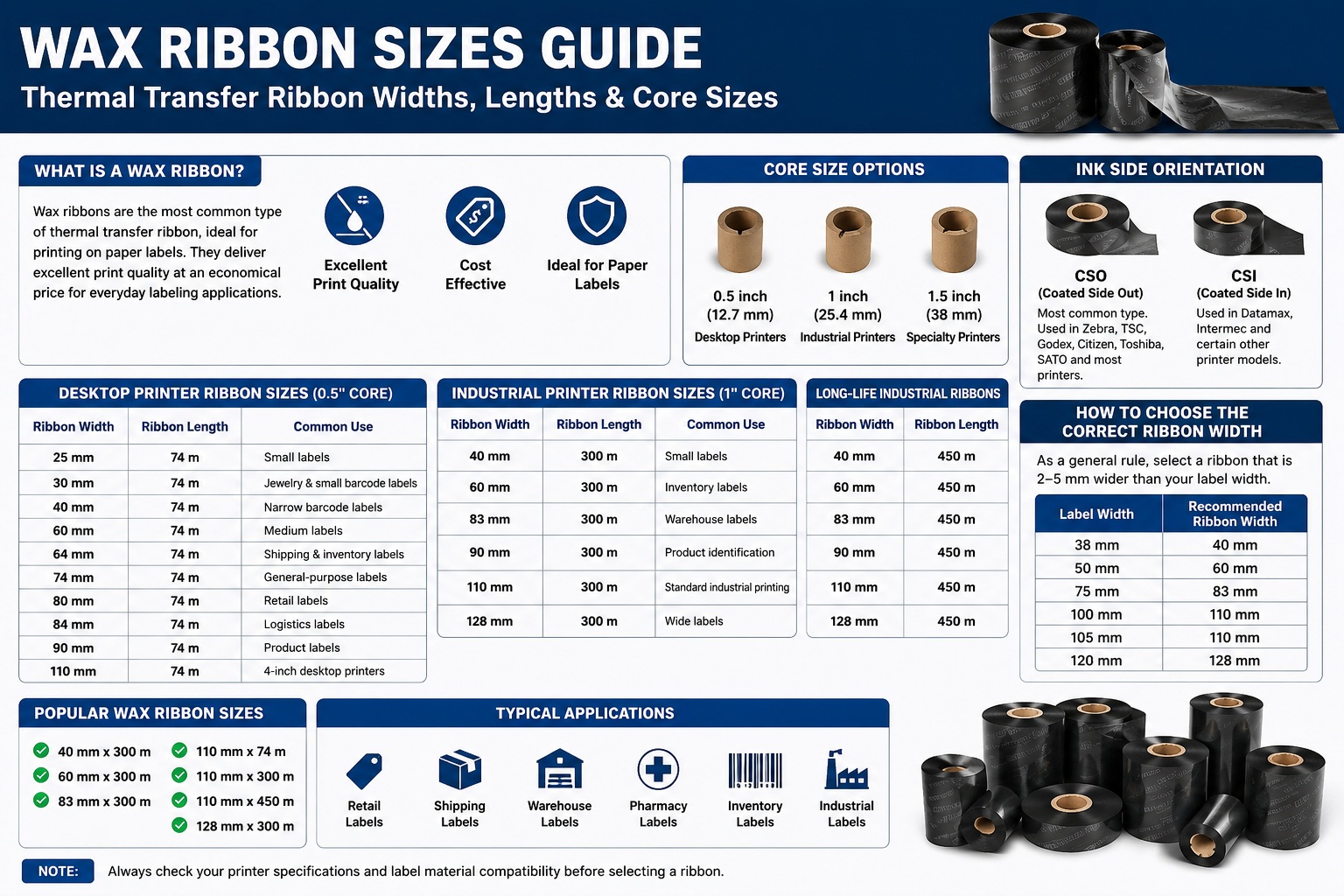
- 0.5-Inch (12.7mm) Core & Dual Core Formats: Primarily utilized inside compact, space-saving desktop label printers (e.g., small desktop Zebra, TSC, or Xprinter series). Dual-core designs incorporate universal notches or built-in core extensions to offer versatility across a broader range of compact desktop models. These rolls feature shorter lengths (typically 74 meters) to match thin physical housings.
- 1.0-Inch (25.4mm) Core: The global industry standard for high-volume industrial printers and heavy-duty mid-range desktop printers. These configurations support massive ribbon capacities (such as 300-meter and 450-meter rolls), which significantly reduces downtime caused by consumable changes.
- Ink Configuration (In vs. Out): Printers feed ribbons differently depending on the mechanical architecture. Ribbons are wound as CSO (Ink Side Out), where the active chemical layer faces away from the core, or CSI (Ink Side In), where the ink faces inward. For example, Zebra printers traditionally require CSO ribbons, whereas Datamax or certain Toshiba printers utilize CSI ribbons. Always verify your hardware parameters prior to deployment.
6. Comprehensive Commercial Ribbon Size Matrix
Below is the standard distribution matrix of commercial ribbon sizes segmented by core size, width, and roll length.
Half-Inch (1/2") Core & Dual Core Sizes (Desktop Printers)
- 64mm × 74m (Dual Core / 1/2" Core): Perfectly suited for mid-width desktop printing tasks like healthcare tracking labels and narrow barcodes.
- 110mm × 74m (Dual Core / 1/2" Core): The universal desktop standard for printing full-width logistics, freight, and standard retail shipping labels.
One-Inch (1") Core Sizes (Industrial & Heavy-Duty Printers)
- 40mm × 300m / 40mm × 450m: Optimized for narrow label applications, apparel hang tags, and jewelry labeling.
- 60mm × 300m: Excellent for medium-width retail shelf-edge labels and inventory tracking.
- 64mm × 450m: Built for longer industrial runs on medium-width materials.
- 80mm × 300m: Widely used for standard product identity tags and intermediate warehouse box labels.
- 84mm × 450m: Maximizes uptime on heavy industrial machines processing mid-to-wide label webs.
- 110mm × 300m / 110mm × 450m: The supreme market standard for international shipping, pallet routing tags, and large chemical drum compliance labels.
7. Cross-Reference: Ribbon Width vs. Label Dimensions
To optimize thermal transfer operations, ribbons must match the exact width profiles of your labels. Operating a ribbon narrower than your label stock exposes the delicate printhead elements directly to the abrasive backing paper, leading to premature printhead failure. Always ensure the ribbon is at least 2mm to 5mm wider than the total web width of your label paper.
**Ribbon extends past the label edge to completely shield the printhead
Popular Commercial Label Matchings:
- 32mm × 20mm Label Stock: Pair with 40mm ribbons (1" core) or 64mm ribbons (1/2" core).
- 52mm × 25mm Label Stock: Pair with 60mm ribbons (1" core) or 64mm ribbons (1/2" core).
- 58mm × 38mm Label Stock: Pair with 60mm or 64mm ribbons.
- 75mm × 50mm Label Stock: Pair with 80mm or 84mm ribbons.
- 100mm × 100mm / 100mm × 150mm Label Stock: Pair with 110mm ribbons (300m or 450m lengths).
8. Troubleshooting Thermal Transfer Print Defects
When printing anomalies occur on an industrial line, they can usually be diagnosed by analyzing the interaction between your ribbon formulation and printer settings:
1. Poor Print Density / Faded Images
- Root Cause: The printhead temperature (darkness setting) is too low for the selected formulation, or the print speed is too high for the ink to melt completely.
- Correction: Incrementally increase the printer darkness setting or lower the print speed. If using a pure resin ribbon, verify that the printer is capable of reaching the required thermal threshold.
2. Smudging and Lack of Sharpness
- Root Cause: Excessive heat settings are causing the ink matrix to boil, bleed, or overflow beyond the intended boundaries of the barcode vector.
- Correction: Lower the printhead temperature setting until lines become sharp and crisp.
3. Diagonal Void Lines across the Label
- Root Cause: The ribbon is wrinkling as it passes over the printhead assembly. This is caused by uneven tension on the ribbon supply/take-up spindles, or an unaligned printhead pressure mechanism.
- Correction: Adjust the printer's internal ribbon tension dials or clean/re-align the printhead pressure toggles.
4. Flaking or Chipping Ink
- Root Cause: Chemical mismatch. A high-cohesion resin ribbon is being printed onto a standard porous paper label, or a cheap wax ribbon is trying to adhere to a slick polyester film.
- Correction: Ensure you pair paper labels with wax/wax-resin ribbons, and synthetic films with resin-based ribbons.
9. Strategic Practical Use Cases
- Logistics and Courier Delivery (E-Commerce): High-volume, rapid-turnaround labels typically pair Premium Wax Ribbons with semi-gloss paper face stock. This strikes an ideal balance between excellent barcode legibility and lower overhead costs.
- Cold Chain Storage and Food Processing: Since labels in these environments encounter freezing temperatures, frost, and condensation, Wax-Resin Ribbons combined with polypropylene synthetic labels prevent barcodes from bleeding or wrinkling.
- Automotive Component and Electronics Tracking: Electronics components endure soldering heat and contact cleaning solvents. These applications pair Premium Resin Ribbons with silver or white polyester labels, ensuring critical serial tracking information remains fully readable throughout the entire product lifecycle.
Operational Pro-Tip: Clean your printer's thermal printhead using a lint-free cotton swab saturated with 99% Isopropyl Alcohol with every single ribbon change. This removes microscopic wax residues, adhesive migration lines, and dust buildup to keep your print quality pristine and maximize your hardware lifespan.
10. Financial and Operational Summary
Investing in premium, correctly specified ribbon formulations delivers measurable operational returns for automated enterprises:
- Elimination of Shipping Disputes: Legible, scratch-resistant tracking barcodes mean zero compliance fines from major global fulfillment hubs due to unscannable tracking numbers.
- Minimized Hardware Replacement Costs: Running premium ribbons with advanced backcoatings allows operators to run lower printhead temperatures, directly extending the service lifespan of expensive printheads and cutting capital replacement expenses.
- Industrial Certifications: Specialized resin-and-synthetic matches provide complete conformity with GHS (Globally Harmonized System) chemical labeling requirements, automotive component specifications, and UL/CSA electronic rating plate standards.