What is a Polypropylene (PP) Labels?
What Are Polypropylene (PP) Labels?
If you've ever purchased a shampoo bottle, chemical container, frozen food package, laboratory sample, or outdoor product, there's a good chance the label was made from Polypropylene (PP).
Polypropylene labels are among the most popular synthetic labels because they combine excellent durability, water resistance, attractive appearance, and affordable cost.
Unlike ordinary paper labels, PP labels are made from plastic film, making them suitable for environments where paper labels would quickly fail.
This guide explains everything beginners need to know about polypropylene labels, including their construction, advantages, disadvantages, printing methods, applications, and how to choose the right ribbon.
What Does PP Mean?
PP stands for Polypropylene.
Polypropylene is a lightweight thermoplastic polymer widely used in packaging, food containers, automotive parts, medical products, and label manufacturing.
When converted into a thin printable film, it becomes an excellent label material.
Many label rolls are simply marked "PP" because it is the internationally recognized abbreviation for Polypropylene.
Why Are PP Labels Popular?
Paper labels work well indoors, but moisture, oils, chemicals, and frequent handling quickly damage them.
Polypropylene labels solve many of these problems.
They offer:
- Water resistance
- Tear resistance
- Oil resistance
- Better durability
- Professional appearance
- Longer lifespan
This makes them suitable for industrial, commercial, and retail applications.
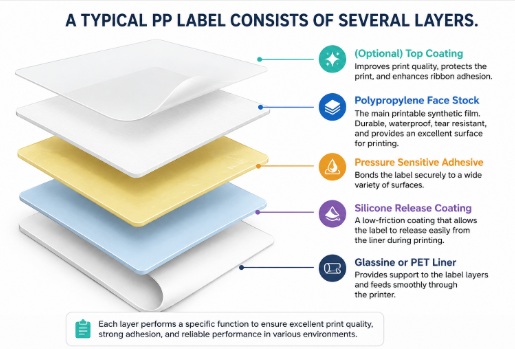
How Is a PP Label Constructed?
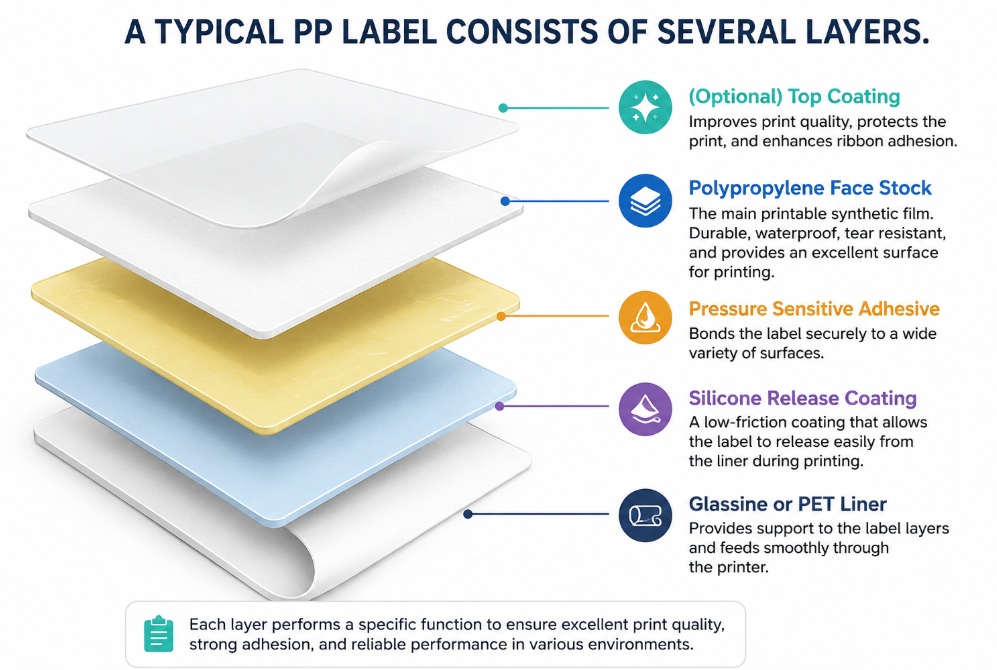
|
Layer |
Purpose |
|
Top Coating |
Improves print quality and ribbon adhesion |
|
PP Face Stock |
Main printable synthetic film |
|
Adhesive |
Sticks to the product |
|
Silicone Layer |
Allows easy release from liner |
|
Liner |
Carries labels through the printer |
Is PP Plastic?
Yes.
Polypropylene is a plastic.
However, it is:
- Flexible
- Lightweight
- Non-toxic
- Recyclable in many regions
- Resistant to moisture
Because of these properties, it is widely used in food and consumer packaging.
Difference Between Paper Labels and PP Labels
|
Feature |
Paper |
Polypropylene (PP) |
|
Water Resistance |
✗ Poor |
✓ Excellent |
|
Tear Resistance |
✗ Low |
✓ High |
|
Oil Resistance |
✗ Low |
✓ Excellent |
|
Chemical Resistance |
Limited |
Good |
|
Outdoor Use |
Poor |
Good |
|
Appearance |
Matte |
Matte or Gloss |
|
Lifespan |
Short |
Long |
Types of PP Labels
PP labels are available in several finishes.
White Matte PP
The most common type.
Features:
- Easy to scan barcodes
- Professional appearance
- Excellent ribbon adhesion
- Low glare
Common for logistics and industrial labels.
White Gloss PP
Provides:
- High-quality appearance
- Bright colors
- Attractive retail packaging
Commonly used on:
- Cosmetics
- Food packaging
- Luxury products
Clear PP
Transparent labels create the "no-label" appearance.
Suitable for:
- Glass bottles
- Beverage packaging
- Premium cosmetics
Silver PP
Metallic silver polypropylene gives products an industrial or premium look.
Often used for:
- Equipment labels
- Electronics
- Warranty labels
- Asset identification
Are PP Labels Waterproof?
Yes.
The label material itself is waterproof.
However, remember:
A waterproof label does not automatically mean the printed information is waterproof.
Print durability depends on:
- Ribbon type
- Printer settings
- Top coating
- Environmental conditions
Are PP Labels Tear Resistant?
Yes.
Unlike paper, polypropylene stretches before tearing.
This makes it ideal for products that experience:
- Frequent handling
- Shipping
- Warehousing
- Outdoor use
Temperature Resistance
Most standard PP labels can withstand approximately:
- -20°C to +80°C
Special industrial PP materials may support wider temperature ranges depending on the manufacturer.
Always verify the material specification for demanding environments.
Which Ribbon Should Be Used?
PP labels are designed for thermal transfer printing.
Choosing the correct ribbon is critical.
|
Ribbon |
Suitable for PP? |
|
Wax |
✗ Not recommended |
|
Wax-Resin |
✓ Good |
|
Resin |
✓ Best |
Wax ribbons generally sit on the surface and can scratch or smear easily on polypropylene.
Wax-resin provides better durability for general-purpose applications.
Resin ribbons offer the highest resistance to abrasion, chemicals, and heat.
Why Doesn't Wax Ribbon Work Well?
Wax ribbon melts at a relatively low temperature.
Because polypropylene is a smooth synthetic surface, wax ink cannot bond strongly.
The result may include:
- Smudging
- Scratching
- Poor durability
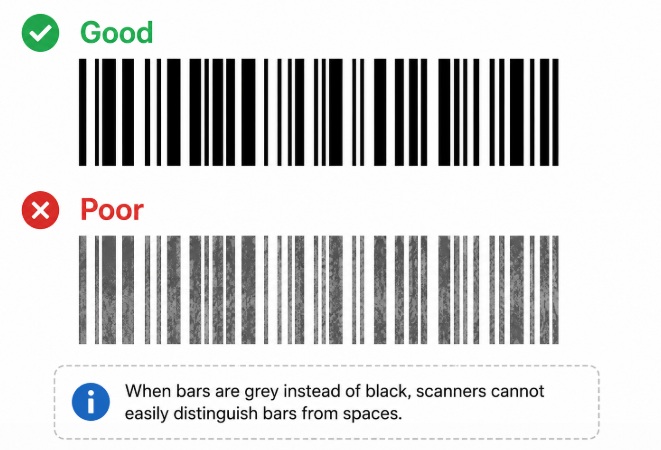
- Reduced barcode reliability
For this reason, resin-based ribbons are preferred.
Common Applications
PP labels are widely used across many industries.
Examples include:
- Product labels
- Cosmetic labels
- Chemical containers
- Frozen food packaging
- Beverage bottles
- Pharmaceutical products
- Laboratory samples
- Warehouse labels
- Asset labels
- Industrial identification
- Outdoor equipment
- Retail packaging
Advantages of PP Labels
✔ Waterproof
✔ Tear resistant
✔ Oil resistant
✔ Good chemical resistance
✔ Professional appearance
✔ Excellent barcode quality
✔ Long service life
✔ Suitable for refrigeration
✔ Available in many finishes
✔ Compatible with thermal transfer printing
Limitations
Although PP labels are highly versatile, they are not perfect.
Potential disadvantages include:
- Higher cost than paper labels
- Requires thermal transfer ribbon
- Resin ribbons increase printing costs
- Not suitable for direct thermal printers unless specifically manufactured for that purpose
Can PP Labels Be Used Outdoors?
Yes.
Polypropylene performs much better outdoors than paper.
However, prolonged exposure to:
- UV sunlight
- Extreme heat
- Harsh chemicals
may eventually reduce its lifespan.
For long-term outdoor use, polyester (PET) labels are often a better choice.
PP vs PET Labels
|
Feature |
PP |
PET |
|
Flexibility |
Excellent |
Moderate |
|
Cost |
Lower |
Higher |
|
Chemical Resistance |
Good |
Excellent |
|
Heat Resistance |
Good |
Excellent |
|
Tear Resistance |
High |
Very High |
|
Outdoor Durability |
Good |
Excellent |
PP is ideal for most everyday industrial applications.
PET is preferred for demanding environments involving extreme temperatures, chemicals, or long-term outdoor exposure.
Storage Recommendations
Store PP labels:
- In a cool, dry location
- Away from direct sunlight
- Between 20–25°C where possible
- At 40–60% relative humidity
- Inside the original packaging until use
Proper storage helps preserve adhesive performance and print quality.
Frequently Asked Questions (FAQ)
Can PP labels be printed using direct thermal printers?
Most PP labels require thermal transfer printing. Special direct thermal synthetic materials exist but are less common.
Are PP labels waterproof?
Yes. The material is waterproof. For waterproof printing, use a suitable ribbon, preferably resin.
Can PP labels be used in freezers?
Yes. Many PP labels are suitable for refrigerated and frozen environments when paired with the correct adhesive.
Are PP labels recyclable?
Polypropylene is recyclable in many regions, but local recycling facilities and label construction may affect recyclability.
Which ribbon is best for polypropylene labels?
Resin ribbons provide the best durability, while wax-resin ribbons are a good balance of cost and performance for many applications.
Conclusion
Polypropylene (PP) labels are one of the most versatile synthetic label materials available. They offer a strong balance of durability, water resistance, tear resistance, and professional appearance, making them suitable for industries ranging from retail and logistics to healthcare and manufacturing.
While they cost more than standard paper labels, their longer lifespan and resistance to moisture, oils, and frequent handling often make them a more economical choice over time. For the best print quality and durability, pair PP labels with a wax-resin or resin thermal transfer ribbon, depending on your application's requirements.
If you need labels that can withstand challenging environments while maintaining sharp barcodes and clear text, polypropylene labels are an excellent choice.