What Is a Wax Thermal Transfer Ribbon? - Complete Guide
What Is a Wax Thermal Transfer Ribbon?
When it comes to thermal transfer printing, selecting the correct ribbon is just as important as choosing the right label material. Among all ribbon types, wax ribbons are the most widely used because they provide an excellent balance between print quality, cost, and printing speed.
Whether you're printing barcode labels, shipping labels, warehouse labels, inventory tags, retail price labels, or logistics stickers, understanding the difference between Standard Wax and Premium Wax ribbons will help you reduce costs while improving print performance.
This guide explains everything you need to know about wax ribbons, including how they work, their advantages, disadvantages, and how to choose the best ribbon for your application.
What Is a Thermal Transfer Ribbon?
A thermal transfer ribbon is a thin polyester film coated with a specialized ink formulation. During printing, the printhead heats specific points on the ribbon, melting the ink and permanently transferring it onto the label surface.
Unlike direct thermal labels that rely on heat-sensitive paper, thermal transfer printing uses both:
- A thermal transfer printer
- A thermal transfer ribbon
- Thermal transfer labels
This combination produces labels that generally last longer and offer better resistance to handling and environmental conditions.
What Is a Wax Ribbon?
A wax ribbon is the most economical type of thermal transfer ribbon. Its ink coating is primarily made from wax compounds designed to melt at relatively low temperatures.
Because wax melts easily, it transfers smoothly onto paper labels while requiring less heat from the printer.
Wax ribbons are ideal for:
- Shipping labels
- Retail price labels
- Warehouse inventory labels
- Carton labels
- Shelf labels
- Product identification labels
- Logistics labels
- General-purpose barcode labels
Wax ribbons are intended mainly for paper-based labels rather than synthetic materials.
How Does a Wax Ribbon Work?
The printing process is straightforward:
- The label passes beneath the printhead.
- The ribbon moves between the printhead and the label.
- Heat melts the wax coating.
- The melted wax transfers to the label surface.
- The ribbon advances, leaving a clean printed image.
Because wax melts at a lower temperature than wax-resin or resin formulations, printers can operate faster while reducing printhead wear.
Types of Wax Ribbons
Wax ribbons are generally available in two main categories:
1. Standard Wax Ribbon
Standard wax ribbons are designed for everyday printing where cost efficiency is the primary concern.
They offer:
- Good barcode quality
- Clear text printing
- High-speed printing
- Excellent performance on coated paper labels
- Low operating cost
These ribbons are suitable for labels that do not require extended durability.
Typical applications include:
- Shipping cartons
- Warehouse boxes
- Retail pricing
- Temporary inventory labels
- Packaging labels
2. Premium Wax Ribbon
Premium wax ribbons use higher-quality wax formulations with additives that improve durability and print performance.
Compared with standard wax, premium wax provides:
- Darker black printing
- Better barcode readability
- Improved scratch resistance
- Better resistance to rubbing
- Higher print consistency
- Improved image sharpness
- Better compatibility across different paper label types
Although premium wax costs more than standard wax, it still remains more affordable than wax-resin or resin ribbons.
Standard Wax vs Premium Wax
|
Feature |
Standard Wax |
Premium Wax |
|
Cost |
Lowest |
Moderate |
|
Print Darkness |
Good |
Excellent |
|
Barcode Quality |
Good |
Excellent |
|
Scratch Resistance |
Basic |
Better |
|
Smudge Resistance |
Basic |
Improved |
|
Print Speed |
Excellent |
Excellent |
|
Printhead Temperature |
Low |
Low to Medium |
|
Suitable Label Material |
Paper |
Paper (coated & uncoated) |
|
Outdoor Use |
Not Recommended |
Limited |
|
Chemical Resistance |
Poor |
Better but limited |
|
Durability |
Moderate |
High for paper labels |
Advantages of Standard Wax Ribbon
1. Lowest Printing Cost
Standard wax ribbons are the most affordable thermal transfer ribbons available, making them ideal for businesses that print thousands of labels daily.
2. High-Speed Printing
Because wax melts at a relatively low temperature, printers can operate at faster speeds while maintaining good print quality.
3. Reduced Printhead Wear
Lower heat requirements place less stress on the thermal printhead, which can contribute to longer printhead life.
4. Excellent for Paper Labels
Standard wax performs well on common paper labels used in warehouses, retail stores, and logistics operations.
5. Suitable for Most General Applications
For labels with a short to medium lifespan, standard wax offers an economical and reliable solution.
Disadvantages of Standard Wax Ribbon
Standard wax ribbons are not suitable for every application.
Limitations include:
- Poor scratch resistance
- Easily smudged by heavy rubbing
- Limited resistance to moisture
- Not suitable for harsh environments
- Not recommended for outdoor use
- Poor resistance to oils and chemicals
- Not suitable for synthetic labels
Advantages of Premium Wax Ribbon
Premium wax ribbons improve upon standard wax in several important areas.
Better Print Quality
Premium wax formulations produce darker, sharper images that improve barcode scanner readability.
Improved Durability
Labels withstand more handling before showing signs of wear.
Better Scratch Resistance
The printed image is less likely to scratch during transportation or warehouse handling.
Cleaner Barcodes
Premium wax produces more consistent barcode edges, reducing scanning errors.
Better Print Consistency
Print quality remains stable across long print runs.
Better Compatibility
Premium wax works well on a wider variety of paper label coatings.
Disadvantages of Premium Wax Ribbon
Although premium wax performs better, it still has some limitations.
These include:
- Higher price than standard wax
- Limited resistance to chemicals
- Limited UV resistance
- Not designed for prolonged outdoor exposure
- Not suitable for polyester or polypropylene labels requiring maximum durability
Typical Applications
Standard Wax
Ideal for:
- Retail labels
- Price tags
- Shipping labels
- Carton labels
- Inventory labels
- Warehouse shelf labels
- Product packaging
- Distribution centers
Premium Wax
Recommended for:
- High-density barcodes
- Long-term warehouse labels
- Distribution centers
- Pharmaceutical carton labels
- Food packaging labels
- Manufacturing labels
- Inventory management
- Retail products requiring cleaner print quality
When Should You Choose Standard Wax?
Choose standard wax if:
- Cost is your highest priority.
- Labels are used indoors.
- Labels have a relatively short service life.
- Labels are printed on paper.
- Moderate durability is acceptable.
- Large printing volumes make economy important.
When Should You Choose Premium Wax?
Premium wax is the better choice if:
- Labels are handled frequently.
- Better scratch resistance is needed.
- Barcode scanning reliability is critical.
- You require darker print quality.
- Products remain in storage for extended periods.
- Customers expect a more professional label appearance.
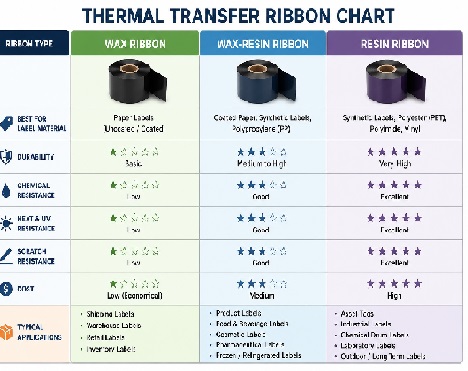
Can Wax Ribbon Be Used on Synthetic Labels?
Generally, no.
Synthetic materials such as polypropylene (PP), polyester (PET), polyethylene (PE), or vinyl typically require:
- Wax-Resin Ribbon for medium durability.
- Resin Ribbon for maximum resistance to heat, chemicals, abrasion, and outdoor conditions.
Using standard wax on synthetic labels often results in poor adhesion and reduced durability.
Storage Tips for Wax Ribbons
To maximize ribbon life:
- Store in a cool, dry environment.
- Avoid direct sunlight.
- Keep away from high humidity.
- Maintain temperatures between 5°C and 35°C.
- Store ribbons in their original packaging until use.
- Avoid dust and contaminants that may affect print quality.
Proper storage helps maintain consistent performance and extends shelf life.
Frequently Asked Questions (FAQ)
Is premium wax worth the extra cost?
For businesses that need cleaner barcodes, improved durability, and fewer scanning issues, premium wax often provides better long-term value despite the higher upfront cost.
Can wax ribbons print QR codes?
Yes. Both standard and premium wax ribbons can produce high-quality QR codes when paired with compatible paper labels and appropriate printer settings.
Which ribbon lasts longer?
Premium wax generally provides better durability on paper labels. For the longest-lasting prints, however, wax-resin or resin ribbons are more suitable.
Do wax ribbons damage the printhead?
No. Because wax ribbons require relatively low heat, they are among the gentlest ribbon types for thermal printheads when used with the correct printer settings.
Are wax ribbons waterproof?
No. Wax ribbons offer limited resistance to moisture. If labels will be exposed to water, cleaning agents, chemicals, or outdoor environments, a wax-resin or resin ribbon is usually a better choice.
Final Thoughts
Wax thermal transfer ribbons remain the most popular choice for everyday barcode and label printing because they combine affordability, reliable print quality, and high-speed performance. For routine applications such as shipping, retail, warehousing, and inventory management, Standard Wax offers exceptional value and low operating costs.
If your labels are handled more frequently or require sharper, darker barcodes with improved resistance to scratching and smudging, Premium Wax is often worth the modest increase in cost. It delivers enhanced durability while retaining the ease of printing associated with wax formulations.
Ultimately, the right ribbon depends on your label material, operating environment, expected label lifespan, and budget. By matching the ribbon to the application, you can improve print quality, reduce scanning errors, extend printhead life, and lower your total cost of ownership.