Thermal Transfer (TT) Printers: Types, Media, and Capabilities
The Ultimate Guide to Thermal Transfer (TT) Printers: Types, Media, and Capabilities
In the world of product identification, logistics, and asset tracking, barcode readability and label durability are non-negotiable. If a label smudges, tears, or fades, a supply chain can grind to a halt. This is where Thermal Transfer (TT) printing shines. Unlike direct thermal printing-which uses heat-sensitive paper that blackens and degrades over time-thermal transfer printing utilizes a heated printhead to melt an ink ribbon directly onto a label substrate.
Whether you are running a boutique e-commerce shop from a home office or managing a multi-site automotive manufacturing plant, understanding the various types of TT printers, media combinations, and structural limitations is key to maximizing efficiency.
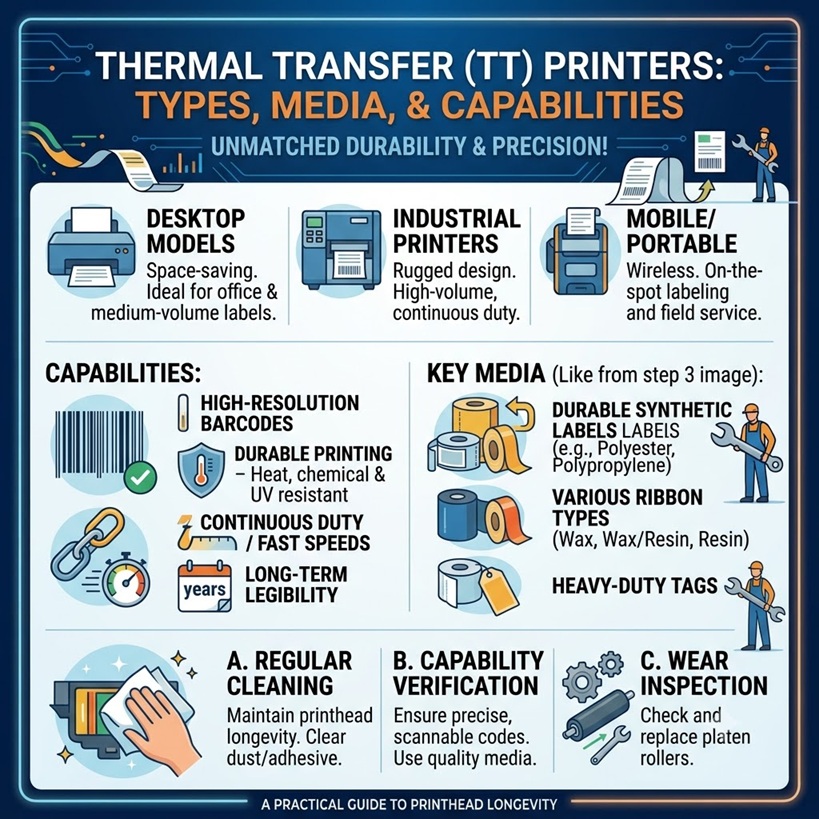
1. The Four Major Types of TT Printers
Thermal transfer printers are broadly categorized by their construction, intended daily print volume (duty cycle), and the physical environment they are built to survive.
Desktop TT Printers
-
The Blueprint: Compact, lightweight, and typically built with plastic clamshell enclosures. They feature a minimal footprint designed to sit comfortably on an office desk or retail counter.
-
Best For: Low-volume printing environments (typically under 1,000–2,000 labels per day). Ideal for retail price tagging, office asset management, and small-scale shipping stations.
-
Limitations: The primary limitation is media capacity. Desktop printers generally accommodate smaller label rolls (usually a 5-inch outer diameter) and shorter ribbon lengths (74 to 110 meters). This requires frequent media changes if pushed beyond their intended duty cycle. Furthermore, their plastic internal gears will rapidly wear down if subjected to continuous, high-speed production runs.
Semi-Industrial TT Printers
-
The Blueprint: A bridge between desktop agility and industrial muscle. These models usually feature a partial metal frame with a hard plastic exterior cover, offering structural rigidity without the extreme weight or cost of a full industrial machine.
-
Best For: Medium-volume applications (2,000 to 5,000 labels per day) such as light manufacturing, healthcare tracking, and regional distribution centers.
-
Limitations: While they can hold larger media rolls (up to an 8-inch outer diameter) and standard 300-meter ribbons, they lack the advanced cooling systems and high-speed processing capabilities of their larger siblings. They can handle intermittent surges in print demands but are not engineered for constant, around-the-clock operation.
Industrial TT Printers
-
The Blueprint: Engineered with die-cast aluminum frames and heavy-duty metal enclosures. These machines are built to survive the dust, vibrations, and temperature fluctuations of warehouses and cross-docking facilities.
-
Best For: High-volume, continuous print operations (5,000 to 15,000+ labels per day). Perfect for large logistics hubs, distribution centers, and standard manufacturing assembly lines.
-
Limitations: Industrial printers have a significantly larger physical footprint, making them unsuitable for tight spaces. They represent a high initial capital investment and require trained staff to calibrate and maintain fine internal parameters like printhead pressure and dark settings.
Heavy-Duty Industrial TT Printers
-
The Blueprint: The absolute titans of the printing industry. These machines feature reinforced steel chassis, ultra-fast internal processors, high-performance cooling systems, and advanced printhead mechanisms engineered to run 24/7/365 without failure.
-
Best For: Mission-critical, zero-downtime environments like chemical processing plants, automotive component tracking, heavy machinery manufacturing, and textile labeling.
-
Limitations: High upfront cost and premium maintenance expenses. These units often feature specialized sub-systems (like integrated RFID encoders or 600 DPI ultra-high-resolution printheads) that require advanced technical expertise to operate. They are massive, immobile, and louder than standard office machinery.
2. Ribbon Compatibility: Wax, Wax-Resin, and Resin
One of the greatest engineering advantages of thermal transfer technology is ribbon versatility. You do not need different printers for different durability levels; a single TT printer can run three completely distinct chemical ribbon formulations depending on the operational requirement:
[Low Heat]  ---> Wax Ribbon       ---> Best for Paper
[Med Heat]  ---> Wax-Resin Ribbon ---> Best for Coated Paper / Synthetics
[High Heat] ---> Resin Ribbon     ---> Best for Vinyl / Polyester
Wax Ribbons
The most cost-effective option available. These ribbons are coated with a paraffin-based ink that has a low melting point ($30^\circ\text{C}$ to $50^\circ\text{C}$). They are ideal for standard shipping labels and shelf tags. However, because the ink sits superficially on the material, it offers minimal resistance to scratching, chemicals, or moisture.
Wax-Resin Ribbons
A hybrid blend of petroleum-based wax and synthetic resin. They require a moderate printhead heat setting ($70^\circ\text{C}$ to $120^\circ\text{C}$) to melt. The added resin forms a stronger mechanical bond with the label, providing excellent resistance to smudging, scratching, and moderate weather exposure. This is the go-to choice for warehouse bins, pharmaceutical tracking, and heavy-handling retail tags.
Pure Resin Ribbons
The ultimate tier of durability. Formulated purely from synthetic polymers, resin requires high printhead temperatures ($120^\circ\text{C}$ to $170^\circ\text{C}$) to cure. When printed, the resin chemically fuses with the synthetic substrate, becoming part of the material itself. It provides unparalleled defense against harsh chemical solvents (like isopropyl alcohol, brake fluid, and gasoline), extreme temperatures, and severe mechanical abrasion.
Important Operational Note: While a single printer can use all three ribbon types, the user must explicitly adjust the Print Speed and Darkness/Heat Settings in the printer driver. Running a resin ribbon on a low-heat "wax setting" will result in a faint, unreadable print because the resin failed to melt completely. Conversely, running a wax ribbon on a high-heat "resin setting" will melt the ribbon backing, bleed the image, and permanently ruin the printhead.
3. Label Material Capabilities
Thermal transfer printers are not locked into paper. Because the printhead applies ink from an external source rather than relying on chemical coatings inside the label, it can print on an incredibly wide range of substrates:
-
Paper Labels (Uncoated & Coated): The standard choice for logistics and shipping. Uncoated paper is highly porous and pairs perfectly with inexpensive wax ribbons. Coated (semi-gloss) papers offer a smoother finish for sharper barcodes and pair well with wax-resin ribbons.
-
Synthetic Labels (Polypropylene): A step up in durability. Polypropylene is a flexible plastic material resistant to tearing and moisture. When paired with a wax-resin ribbon, it creates excellent outdoor tags, asset labels, and chilled-food packaging indicators.
-
Vinyl Labels: Celebrated for extreme flexibility and conformity. Vinyl stretch-fits perfectly around curved surfaces, pipes, and cables. Highly UV-resistant, it is typically paired with resin ribbons for outdoor safety signage and chemical drum marking.
-
Polyester (PET) Labels: The gold standard for industrial applications. Polyester features massive dimensional stability, meaning it will not shrink, stretch, or degrade when exposed to intense heat, freezing environments, or chemical washes. When matched with a high-grade pure resin ribbon, polyester labels can survive inside car engines, aerospace components, and industrial laboratories for decades.
4. Weighing the Pros and Cons of TT Printers
Before investing in thermal transfer technology, it is essential to look at the broader operational advantages and operational trade-offs.
Advantages
-
Archival Durability: Images do not fade under sunlight or bleed when exposed to moisture and chemicals. A resin-on-polyester label can last the entire lifecycle of an industrial asset.
-
Substrate Versatility: The capability to print on paper, plastic, fabric, and metallic foils using a single machine is unmatched by any other printing technology.
-
Sharp, Scannable Barcodes: Because the heat application is precisely controlled at a pixel level, edge definition is incredibly clean. This produces high-contrast 1D and 2D codes that scanners can read instantly on the first pass.
-
Low Long-Term Maintenance: TT printers have very few moving parts. There are no ink nozzles to clog, aerosol filters to swap, or toner drums to replace, resulting in massive operational uptime.
Disadvantages
-
Ribbon Supply Waste: For every inch of label printed, an exact inch of ribbon must be fed through the machine, regardless of how much ink is actually transferred. This creates continuous consumable waste.
-
Data Security Risks: The used ribbon roll acts as a structural negative mirror image of what was printed. If you print sensitive customer data, corporate assets, or proprietary serialization codes, the discarded ribbon rolls must be securely shredded to prevent data leaks.
-
Monochromatic Limitations: TT printers are structurally designed to print one color at a time (determined by the color of the ribbon installed). True multi-color printing requires highly specialized, multi-station industrial machines that are cost-prohibitive for most operations.
-
Consumable Matching Complexity: Achieving the perfect print requires careful calibration between three variables: printer heat, ribbon chemistry, and label material. A mismatch can result in illegible prints or premature printhead failure.
By matching your daily volume to the appropriate printer frame-and carefully aligning your ribbon chemistry with your substrate requirements-you can create an airtight labeling infrastructure that protects your data, assets, and supply chain integrity.