What Is a Polyester (PET) Label?
What Are Polyester (PET) Labels? A Beginner's Guide to Durable Synthetic Labels
If you've ever seen a barcode label that remains perfectly readable after years of use on industrial equipment, electrical panels, or outdoor machinery, chances are it was printed on a Polyester (PET) label.
Unlike ordinary paper labels, PET labels are designed to withstand harsh environments including moisture, chemicals, abrasion, heat, and sunlight.
This guide explains everything beginners need to know about Polyester (PET) labels, where they are used, and how to choose the right ribbon for printing them.
What Does PET Stand For?
PET stands for Polyethylene Terephthalate.
It is a strong engineering plastic belonging to the polyester family. Because of this, suppliers may describe the material as:
- Polyester Labels
- PET Labels
- Polyester PET Labels
These names generally refer to the same synthetic label material.
What Is a Polyester Label?
A Polyester (PET) label is a synthetic self-adhesive label made from a thin polyester film instead of paper.
Because the face material is plastic rather than paper, it offers significantly better durability and environmental resistance.
PET labels are commonly used wherever labels must remain readable for many years.
How Is a PET Label Constructed?
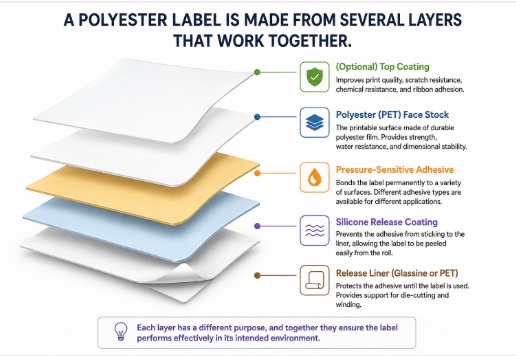
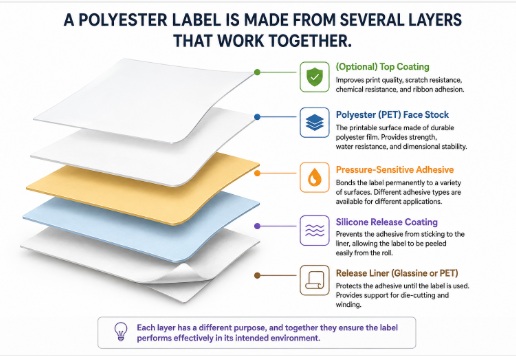
A polyester label is made from several layers that work together.
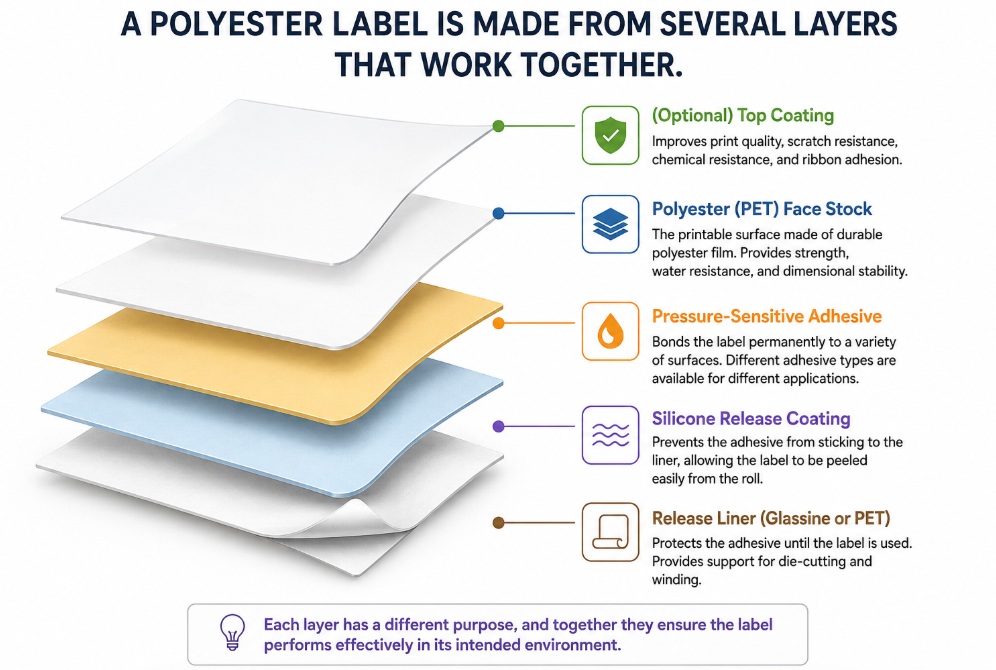
Each layer has a different purpose.
Top Coating (Optional)
Some PET labels include a protective top coating that improves:
- Print quality
- Scratch resistance
- Chemical resistance
- Ribbon adhesion
Premium industrial labels almost always include a top coating.
Polyester Face Stock
This is the visible plastic layer where information is printed.
It provides:
- High strength
- Waterproof properties
- Excellent dimensional stability
- Long service life
Pressure-Sensitive Adhesive
The adhesive permanently bonds the label to the product.
Different adhesive types are available depending on the application:
- Permanent
- High-tack
- Freezer grade
- High-temperature
- Removable
Silicone Release Coating
A thin silicone coating prevents the adhesive from sticking permanently to the liner.
Without it, labels could not be peeled from the roll.
Release Liner
The liner protects the adhesive until the label is applied.
Common liner materials include:
- Glassine paper
- PET liner
- Kraft paper
Why Choose PET Instead of Paper?
Paper labels are inexpensive and suitable for short-term use.
However, they are easily damaged by:
- Water
- Oils
- Chemicals
- Heat
- Scratches
- Sunlight
Polyester labels are designed specifically to solve these problems.
Advantages of Polyester (PET) Labels
Excellent Durability
PET labels resist tearing, scratching, and wear much better than paper labels.
Waterproof
Since polyester is plastic, it does not absorb water.
This makes PET labels suitable for:
- Refrigerated products
- Outdoor equipment
- Laboratories
- Warehouses
- Manufacturing environments
Chemical Resistant
PET labels withstand exposure to many:
- Cleaning chemicals
- Oils
- Grease
- Alcohol
- Mild solvents
This is one reason they are widely used in industrial environments.
Heat Resistant
Many PET labels tolerate elevated temperatures far better than paper.
Some industrial-grade PET materials remain stable above 120°C, while specialist constructions can withstand even higher temperatures depending on the adhesive and coating.
Excellent Barcode Printing
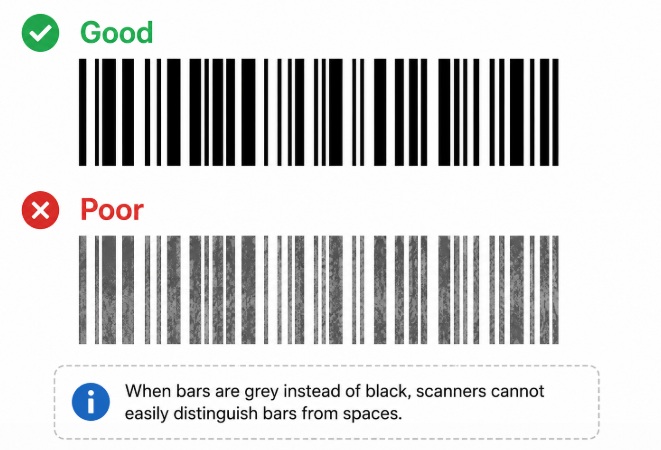
PET provides a very smooth surface that produces sharp barcode printing with thermal transfer printers.
Properly printed PET labels scan reliably even after years of service.
Long Service Life
PET labels are designed for permanent identification rather than temporary labeling.
Many remain readable for over ten years indoors.
Disadvantages of PET Labels
Although PET labels offer many benefits, they also have some limitations.
- More expensive than paper labels
- Less flexible than polypropylene (PP)
- Usually requires a resin ribbon for maximum durability
- Not biodegradable
Common PET Label Colours
Polyester labels are available in many finishes.
The most common include:
- White Gloss
- White Matte
- Silver Matte
- Silver Gloss
- Clear
- Gold
- Black
Silver polyester labels are especially popular for equipment identification and asset tracking.
Common Uses of PET Labels
PET labels are found in many industries.
Examples include:
- Asset labels
- Barcode labels
- Serial number labels
- Electrical panels
- Industrial machinery
- Laboratory equipment
- Medical devices
- Electronic products
- PCB identification
- Chemical containers
- Safety labels
- Rating plates
- Outdoor equipment
- Telecommunications equipment
- Warehouse identification
PET Labels in Barcode Printing
PET labels are one of the best materials for thermal transfer barcode printing.
Because the surface is smooth and durable, printed barcodes remain readable for many years when the correct ribbon is used.
This makes PET ideal for:
- Fixed asset tracking
- Warehouse equipment
- Manufacturing
- Product identification
- Long-term inventory labels
Which Ribbon Should Be Used?
Choosing the correct thermal transfer ribbon is important.
| Ribbon Type | Suitable for PET? | Durability |
|---|---|---|
| Wax | ❌ Not Recommended | Low |
| Wax-Resin | ✔ Acceptable | Medium |
| Resin | ✅ Recommended | Excellent |
A resin ribbon bonds strongly with the polyester surface, producing labels that resist scratching, chemicals, moisture, and heat.
For industrial applications, resin ribbons are the preferred choice.
PET vs Paper Labels
| Feature | PET | Paper |
|---|---|---|
| Waterproof | ✔ | ✘ |
| Tear Resistant | Excellent | Poor |
| Chemical Resistance | Excellent | Poor |
| Outdoor Use | Yes | Limited |
| Heat Resistance | Excellent | Poor |
| Lifespan | 10–20+ Years | Months to a Few Years |
| Cost | Higher | Lower |
PET vs Polypropylene (PP)
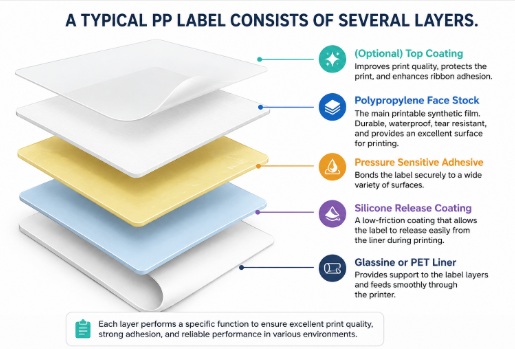
Both PET and PP are synthetic materials, but they are designed for different purposes.
| Feature | PET | PP |
|---|---|---|
| Strength | Excellent | Good |
| Flexibility | Moderate | High |
| Scratch Resistance | Excellent | Good |
| Chemical Resistance | Excellent | Good |
| Heat Resistance | Better | Moderate |
| Cost | Higher | Lower |
| Industrial Asset Labels | Excellent | Good |
| Retail Product Labels | Good | Excellent |
In general:
- Choose PP for retail products, food packaging, cosmetics, and flexible packaging.
- Choose PET for industrial, durable, and long-life labeling applications.
Expected Lifespan
With proper storage, quality adhesive, and a resin ribbon, PET labels can last:
- Indoor use: 10–20+ years
- Outdoor use: 3–10+ years, depending on UV exposure, weather conditions, and surface type
Tips for Printing PET Labels
To achieve the best results:
- Use a quality resin ribbon.
- Keep the printhead clean.
- Match the printer settings to the label material.
- Avoid touching the printable surface before printing.
- Store labels in a cool, dry place away from direct sunlight.
Frequently Asked Questions (FAQ)
Are PET labels waterproof?
Yes. Polyester labels are waterproof and suitable for wet environments.
Can PET labels be used outdoors?
Yes. Many PET labels are designed for outdoor applications and resist UV light, moisture, and temperature changes.
Are PET labels tear-proof?
PET labels are highly tear-resistant and far stronger than paper labels, although they can still be cut with sharp tools.
Can I print PET labels using a direct thermal printer?
No. Most PET labels require a thermal transfer printer and a compatible ribbon, typically resin.
Are PET labels suitable for asset tracking?
Yes. PET is one of the most popular materials for asset labels because it provides long-term durability and excellent barcode readability.
Final Thoughts
Polyester (PET) labels are among the most durable self-adhesive labels available. Their resistance to water, chemicals, abrasion, and heat makes them the preferred choice for industrial, electrical, medical, laboratory, and asset identification applications.
Although they cost more than paper labels, their long service life and reliable performance often make them the most cost-effective solution for labels that need to last for years.
Whether you're printing equipment identification labels, barcode labels, serial numbers, or outdoor signage, PET labels combined with a quality resin ribbon provide excellent durability, sharp print quality, and dependable scanning performance.