What Is a Resin Ribbon? Regular vs Premium vs Chemical-Resistant - Complete Guide
What Is a Resin Ribbon?
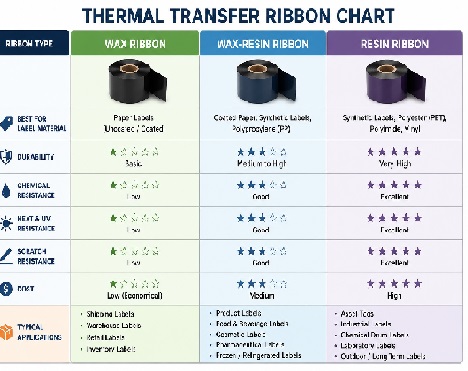
When labels must survive harsh environments, frequent handling, chemicals, outdoor exposure, or extreme temperatures, thermal transfer resin ribbons are the preferred choice. Unlike wax or wax resin ribbons, resin ribbons are designed to produce highly durable prints that bond strongly to synthetic label materials.
Resin ribbons are widely used in industries where labels must remain readable for years, even when exposed to abrasion, moisture, solvents, oils, cleaning agents, or sunlight. They are commonly found in electronics manufacturing, healthcare, laboratory environments, automotive production, aerospace, asset management, and industrial identification.
This guide explains what a resin ribbon is, how it works, the differences between regular resin, premium resin, and chemical-resistant resin, along with their advantages, disadvantages, and best applications.
What Is a Thermal Transfer Resin Ribbon?
A resin ribbon is a thermal transfer printing ribbon whose ink coating is primarily made from synthetic resin compounds rather than wax.
During printing, the thermal printhead applies higher temperatures to melt the resin coating, permanently bonding it to compatible label materials. The resulting print is extremely durable and resistant to abrasion, moisture, chemicals, and environmental stress.
Compared with wax and wax resin ribbons, resin ribbons require:
- Higher print temperatures
- Synthetic labels for best performance
- Proper printer calibration
- Slower print speeds in some applications
In return, they provide the highest level of print durability available in thermal transfer printing.
How Does a Resin Ribbon Work?
The printing process follows the same thermal transfer principle:
- A synthetic label passes beneath the printhead.
- The ribbon moves between the printhead and the label.
- The printhead heats selected areas of the ribbon.
- The resin coating melts and bonds firmly to the label surface.
- The used ribbon advances while the printed label exits the printer.
Unlike wax ribbons, the resin forms a tougher bond that is difficult to scratch, smear, or remove.
Compatible Label Materials
Resin ribbons are intended primarily for synthetic labels rather than standard paper labels.
Common compatible materials include:
- Polyester (PET)
- Polypropylene (PP)
- Polyethylene (PE)
- Polyimide
- Vinyl (PVC)
- Polyolefin
- Durable synthetic films
- Tamper-evident labels
- Security labels
- Asset tags
While some resin ribbons can print on coated paper, they are generally chosen for synthetic applications where maximum durability is required.
Types of Resin Ribbons
Resin ribbons are available in several formulations to suit different environments and performance requirements.
1. Regular Resin Ribbon
Regular resin ribbons are designed for industrial and commercial applications that require high durability without the added performance features of premium formulations.
Features
- Excellent print quality
- Strong adhesion to synthetic labels
- Good abrasion resistance
- Good moisture resistance
- Good solvent resistance
- High barcode readability
Typical Applications
- Asset labels
- Equipment identification
- Electronics labels
- Warehouse assets
- Industrial product labels
- Compliance labels
- Rating plates
- Cable identification
- Inventory tags
Advantages of Regular Resin Ribbon
- Excellent durability
- Long label lifespan
- Sharp barcode printing
- Resistant to scratches
- Suitable for outdoor use (with compatible label materials)
- Good UV resistance
- Strong adhesion on synthetic labels
- Better chemical resistance than wax resin
Disadvantages of Regular Resin Ribbon
- Higher cost than wax and wax resin ribbons
- Requires higher printhead temperature
- Not economical for everyday paper labels
- Slower print speeds may be needed
- Requires compatible synthetic media
2. Premium Resin Ribbon
Premium resin ribbons are manufactured using advanced resin formulations that improve print density, flexibility, durability, and environmental resistance.
These ribbons are designed for demanding industrial applications where label failure is not acceptable.
Additional Features
- Darker black print
- Higher print definition
- Superior abrasion resistance
- Better flexibility
- Excellent edge sharpness
- Longer printhead life with optimized formulations
- Outstanding barcode performance
- Superior image permanence
Typical Applications
Premium resin ribbons are commonly used for:
- Medical devices
- Electronics manufacturing
- Automotive components
- Aerospace parts
- Pharmaceutical labeling
- Laboratory samples
- Long-life asset tracking
- Industrial machinery
- Government equipment
- High-value inventory
Advantages of Premium Resin Ribbon
Outstanding Print Quality
Produces crisp text, fine graphics, QR codes, and dense barcodes that remain easy to scan.
Superior Abrasion Resistance
Labels withstand repeated handling, friction, and mechanical wear.
Better Heat Resistance
Suitable for applications exposed to elevated temperatures, depending on the label material.
Longer Outdoor Life
When paired with UV-stable synthetic labels, premium resin prints maintain legibility for extended outdoor use.
Excellent Adhesion
Forms a strong bond with high-performance synthetic materials, reducing the risk of image lifting or flaking.
Disadvantages of Premium Resin Ribbon
- Higher purchase cost
- Requires careful printer calibration
- Higher energy consumption due to increased print temperatures
- Overkill for basic indoor paper labeling applications
3. Chemical-Resistant Resin Ribbon
Chemical-resistant resin ribbons are specialized formulations designed for environments where labels are routinely exposed to aggressive chemicals, solvents, fuels, disinfectants, and cleaning agents.
These are among the highest-performance thermal transfer ribbons available.
Chemical Resistance
Depending on the specific ribbon and label combination, these ribbons can resist exposure to:
- Isopropyl alcohol (IPA)
- Acetone (to varying degrees)
- Xylene
- Engine oils
- Hydraulic fluids
- Brake fluid
- Diesel fuel
- Gasoline
- Industrial cleaners
- Laboratory reagents
- Mild acids
- Mild alkalis
- Disinfectants
- Medical cleaning solutions
Always verify compatibility with the ribbon and label manufacturer for the exact chemicals and exposure conditions in your application.
Common Applications
Chemical-resistant resin ribbons are widely used in:
- Chemical manufacturing
- Oil and gas
- Pharmaceutical production
- Clinical laboratories
- Hospitals
- Electronics manufacturing
- Automotive assembly
- Aerospace
- Medical devices
- Industrial plants
- Laboratory specimen identification
Advantages of Chemical-Resistant Resin Ribbon
Maximum Chemical Resistance
Labels remain readable even after repeated exposure to many industrial chemicals and cleaning agents.
Extreme Durability
Provides excellent resistance to:
- Abrasion
- Scratching
- Smearing
- Moisture
- Heat
- UV exposure
Long Service Life
Many labels printed with chemical-resistant resin can remain legible for years when paired with durable synthetic media.
Reliable Barcode Performance
Maintains high scan accuracy throughout the label's service life.
Disadvantages of Chemical-Resistant Resin Ribbon
- Highest purchase cost
- Requires premium synthetic labels
- Higher print temperatures
- Not suitable for standard paper labels
- More specialized than most general-purpose applications require
Regular vs Premium vs Chemical-Resistant Resin
|
Feature |
Regular Resin |
Premium Resin |
Chemical-Resistant Resin |
|
Cost |
Medium-High |
High |
Highest |
|
Print Quality |
Excellent |
Outstanding |
Outstanding |
|
Scratch Resistance |
Excellent |
Superior |
Maximum |
|
Chemical Resistance |
Good |
Very Good |
Excellent |
|
Heat Resistance |
Good |
Excellent |
Excellent |
|
UV Resistance |
Good |
Excellent |
Excellent |
|
Outdoor Durability |
Good |
Excellent |
Excellent |
|
Synthetic Labels |
Excellent |
Excellent |
Excellent |
|
Paper Labels |
Limited |
Limited |
Not Recommended |
|
Long-Term Asset Labels |
Good |
Excellent |
Excellent |
When Should You Choose Regular Resin?
Choose regular resin when:
- Printing durable asset labels.
- Using polyester or polypropylene labels.
- Moderate chemical resistance is sufficient.
- Long-lasting indoor labels are required.
- Cost is an important consideration.
When Should You Choose Premium Resin?
Premium resin is ideal if:
- Labels require exceptional print quality.
- Products are exposed to outdoor environments.
- Long-term asset identification is critical.
- Barcodes must remain readable for many years.
- Labels experience frequent handling and abrasion.
When Should You Choose Chemical-Resistant Resin?
Chemical-resistant resin is the best option when labels must withstand:
- Industrial solvents
- Oils and lubricants
- Fuel exposure
- Hospital disinfectants
- Laboratory chemicals
- Pharmaceutical production
- Manufacturing wash-down processes
- Harsh industrial environments
Storage Recommendations
To maintain optimal ribbon performance:
- Store between 5°C and 35°C.
- Avoid direct sunlight.
- Protect from excessive humidity.
- Keep ribbons in their original packaging until use.
- Store in a clean, dust-free environment.
Proper storage helps preserve print quality and ribbon lifespan.
Frequently Asked Questions
Can resin ribbons print on paper labels?
Some coated paper labels may be compatible with certain resin ribbons, but resin ribbons are generally intended for synthetic materials. For paper labels, wax or wax resin ribbons are often more suitable and economical.
Are resin ribbons waterproof?
When paired with compatible synthetic labels, resin ribbon prints offer excellent resistance to water, humidity, and many environmental conditions. Performance depends on the specific ribbon, label material, and application.
Can resin ribbons be used outdoors?
Yes. Resin ribbons combined with UV-stable synthetic labels are widely used for outdoor asset labels, equipment identification, warning labels, and industrial signage.
Which resin ribbon lasts the longest?
Chemical-resistant and premium resin ribbons generally provide the highest durability, especially when used with high-performance polyester or polyimide labels. Actual lifespan depends on environmental conditions, label material, and exposure to heat, sunlight, and chemicals.
Does resin ribbon require special printers?
Most thermal transfer barcode printers support resin ribbons, provided they are configured with the appropriate heat, speed, and pressure settings. Always consult your printer manufacturer's recommendations for optimal performance.
Final Thoughts
Resin thermal transfer ribbons are the highest-performing ribbon category available for demanding labeling applications. Whether you choose a regular resin ribbon for durable asset identification, a premium resin ribbon for superior print quality and long-term outdoor performance, or a chemical-resistant resin ribbon for harsh industrial and laboratory environments, selecting the correct ribbon can significantly improve label durability and reliability.
By matching the ribbon with the appropriate synthetic label material and properly configuring your thermal transfer printer, you can produce labels that resist abrasion, moisture, UV exposure, heat, and many chemicals while maintaining excellent barcode readability throughout their service life.