Barcode Printer Sensors Explained: Gap, Black Mark, Transmissive & Reflective
Understanding the Difference Between Gap Sensors, Black Mark Sensors, Transmissive Sensors, and Reflective Sensors
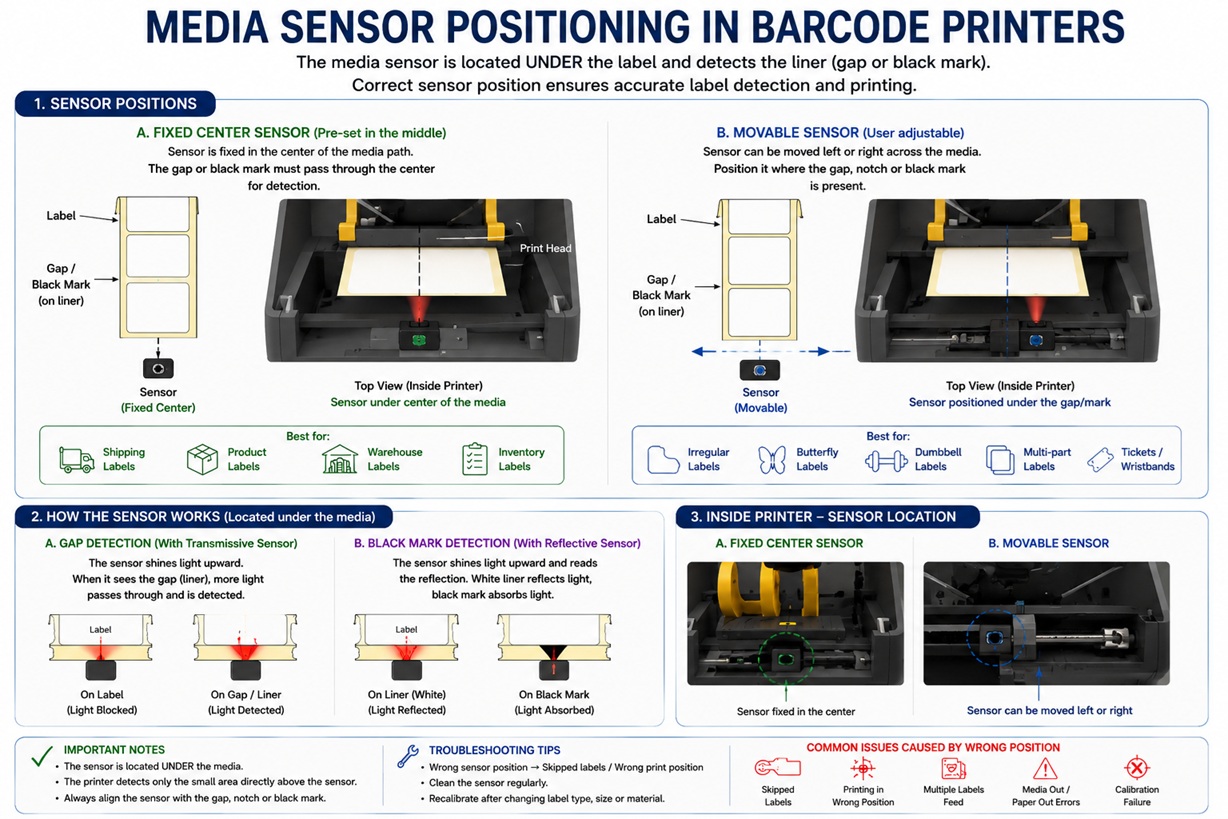
Many people use the terms Gap Sensor, Black Mark Sensor, Transmissive Sensor, and Reflective Sensor interchangeably. However, these terms describe different aspects of how a barcode printer detects media.
A Gap Sensor and a Black Mark Sensor describe what the printer is looking for, while a Transmissive Sensor and a Reflective Sensor describe how the sensor detects it.
Understanding this difference makes it much easier to configure your printer correctly and troubleshoot media detection problems.
Gap Sensor
A Gap Sensor is a media detection method.
Its purpose is to detect the empty space (gap) between two labels.
The printer uses this gap to determine where one label ends and the next label begins.
Gap sensing is the most common method used with paper barcode labels.
Detects
- Gap between labels
- Exposed release liner
Common Applications
- Shipping labels
- Product labels
- Warehouse labels
- Retail labels
- Inventory labels
Black Mark Sensor
A Black Mark Sensor is also a media detection method.
Instead of looking for the gap, the printer looks for a printed black registration mark on the liner or on the back of the media.
Whenever the sensor detects the black mark, it knows where the next label starts.
Detects
- Printed black registration mark
Common Applications
- Transparent labels
- Wristbands
- Tickets
- Jewellery labels
- Continuous media
- Synthetic labels
Transmissive Sensor
A Transmissive Sensor is a sensor technology.
It consists of:
- An LED light source positioned on one side of the media.
- A light receiver positioned directly opposite.
The sensor measures how much light passes through the media.
How it Works
When a label is positioned over the sensor:
Very little light passes through.
When the gap or exposed liner reaches the sensor:
More light reaches the receiver.
The printer recognises this change and determines the label position.
Transmissive sensors are primarily used for Gap Sensing.
Reflective Sensor
A Reflective Sensor is another sensor technology.
Instead of shining light through the media, both the LED and receiver are located on the same side.
The sensor shines light onto the media surface and measures the amount of reflected light.
How it Works
White liner reflects a large amount of light.
Black registration marks absorb most of the light.
When the reflected light suddenly decreases, the printer recognises the black mark and determines the next print position.
Reflective sensors are primarily used for Black Mark Sensing.
Detection Method vs Sensor Technology
This is the easiest way to understand the difference.
|
Term |
What It Means |
Detects |
|
Gap Sensor |
Detection Method |
Gap between labels |
|
Black Mark Sensor |
Detection Method |
Printed black mark |
|
Transmissive Sensor |
Sensor Technology |
Measures light passing through the media |
|
Reflective Sensor |
Sensor Technology |
Measures light reflected from the media |
How They Work Together
In most barcode printers:
Gap Detection is performed using a Transmissive Sensor.
Black Mark Detection is performed using a Reflective Sensor.
Think of it this way:
- Gap and Black Mark answer the question: "What is the printer looking for?"
- Transmissive and Reflective answer the question: "How does the printer detect it?"
Can One Printer Support Both?
Yes.
Many desktop and industrial barcode printers include both a transmissive sensor and a reflective sensor.
This allows the user to switch between:
- Gap labels
- Black mark labels
without changing the printer.
Some entry-level printers, however, may support only gap sensing, so it is always advisable to check the printer's specifications before purchasing specialised media.
Quick Comparison
|
Feature |
Gap Sensor |
Black Mark Sensor |
Transmissive Sensor |
Reflective Sensor |
|
Category |
Detection Method |
Detection Method |
Sensor Technology |
Sensor Technology |
|
Detects |
Gap between labels |
Black registration mark |
Light passing through media |
Reflected light |
|
Light Source Position |
Uses transmissive sensor |
Uses reflective sensor |
Opposite sides of media |
Same side of media |
|
Most Common Media |
Paper labels |
Transparent & specialty labels |
Gap labels |
Black mark labels |
|
Works with Transparent Labels |
Usually difficult |
Excellent |
Limited |
Excellent |
Simple Analogy
Imagine driving a car:
- Gap Sensor = "Look for the opening in the road."
- Black Mark Sensor = "Look for the painted black line."
- Transmissive Sensor = "Use a flashlight shining through the road."
- Reflective Sensor = "Shine a flashlight onto the road and observe how much light bounces back."