Label Adhesives Explained: Types, Uses, Advantages & Disadvantages
Label Adhesives Explained: Types, Uses, Advantages & Disadvantages
Have you ever peeled a label from a product only to find it left sticky residue behind? Or perhaps you've noticed some labels fall off after being placed in a freezer or exposed to moisture.
The difference is usually not the label material-it's the adhesive.
The adhesive, often called the "glue," is one of the most important components of a self-adhesive label. Choosing the wrong adhesive can cause labels to peel off, curl, slide, or fail completely, even when the label itself is printed perfectly.
In this guide, we'll explain the most common adhesive types used in label manufacturing, their strengths and weaknesses, and how to choose the right one for your application.
What Is a Label Adhesive?
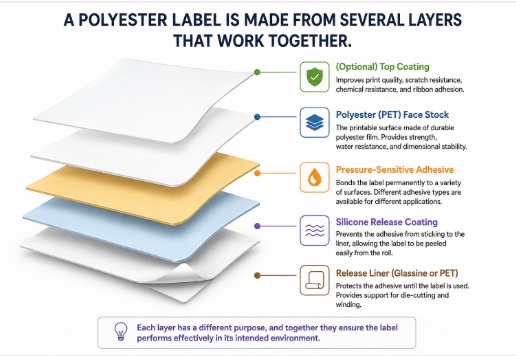
A label adhesive is the pressure-sensitive layer applied between the face stock and the release liner.
Unlike traditional glue that must dry or cure, pressure-sensitive adhesives bond to a surface when firm pressure is applied.
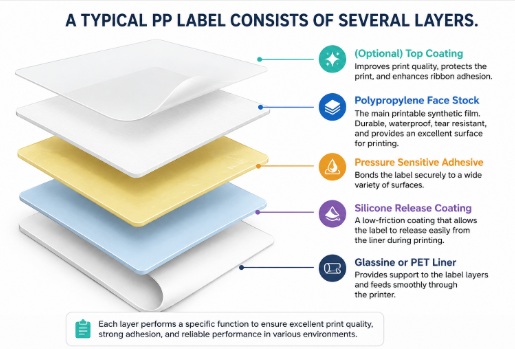
A typical label is made of five layers:
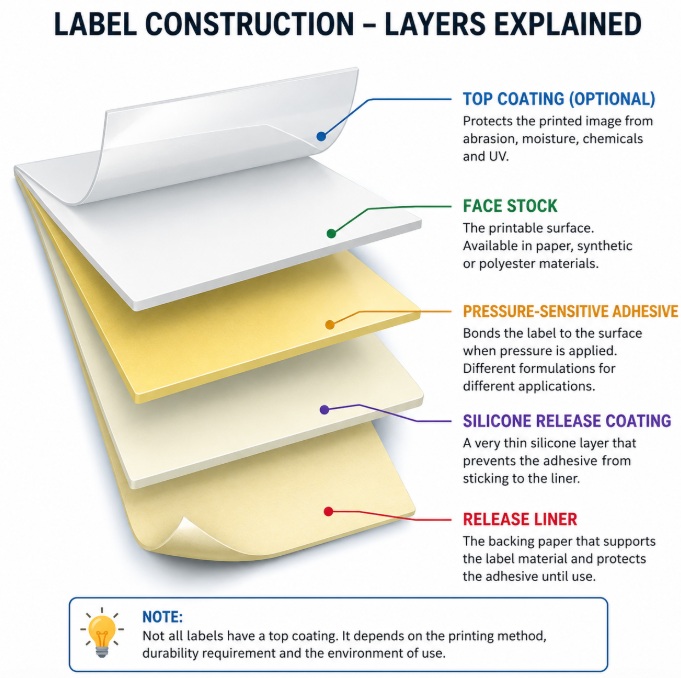
The adhesive determines how well the label sticks, how long it stays attached, and whether it can be removed cleanly.
Why Is the Adhesive So Important?
A label may look perfect when first applied, but if the adhesive is unsuitable, problems can appear later.
Common issues caused by selecting the wrong adhesive include:
- Labels peeling from curved surfaces
- Edges lifting over time
- Labels falling off in cold storage
- Adhesive softening under heat
- Sticky residue left after removal
- Labels failing on rough or textured materials
- Poor performance on oily or dusty surfaces
Choosing the correct adhesive is just as important as selecting the right label material or printer.
Types of Label Adhesives
1. Permanent Adhesive
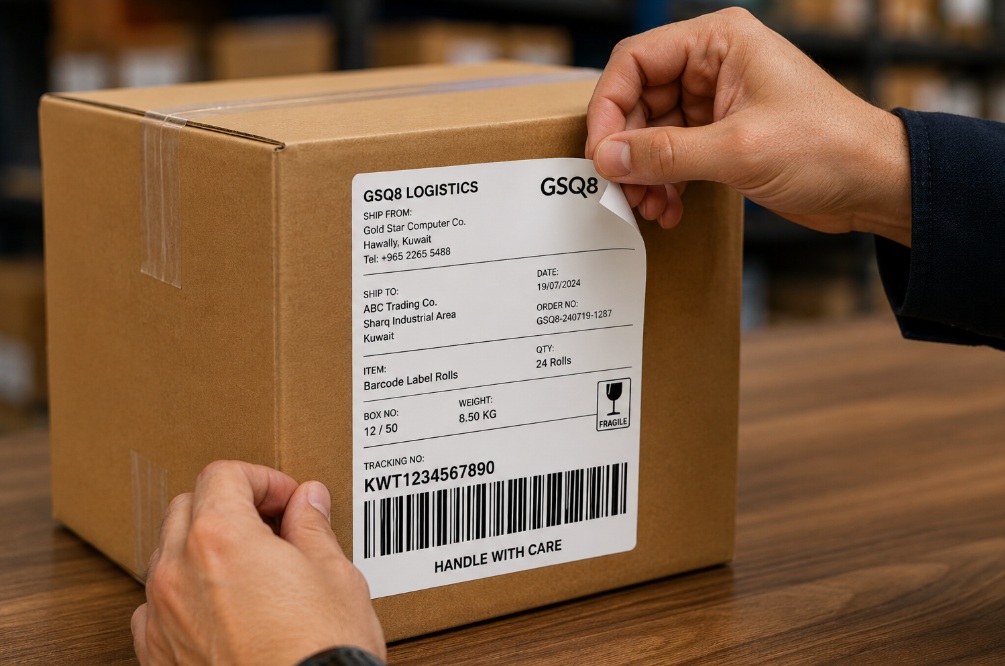
Permanent adhesive is the most common type used in label manufacturing. It is designed to remain attached for the life of the product.
Advantages
- Strong bond
- Excellent long-term adhesion
- Suitable for paper, plastic, glass, and metal
- Cost-effective
- Available in many formulations
Disadvantages
- Difficult to remove
- Often leaves adhesive residue
- May damage paper packaging when removed
Common Uses
- Shipping labels
- Product labels
- Barcode labels
- Asset labels
- Warehouse inventory
2. Removable Adhesive
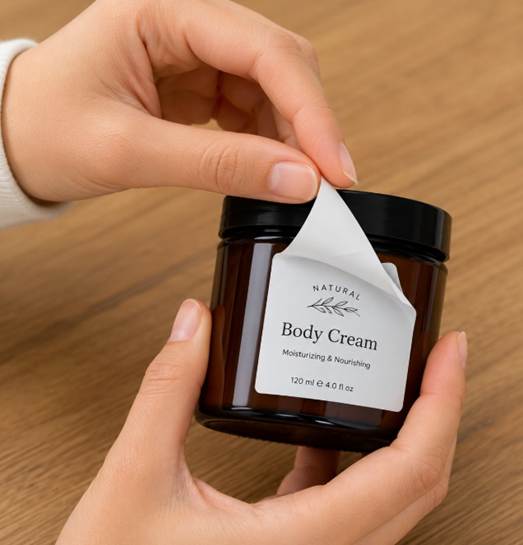
Removable adhesive is designed to hold securely while allowing clean removal later.
Advantages
- Leaves little or no residue
- Easy to reposition
- Ideal for temporary identification
Disadvantages
- Lower bond strength
- Not suitable for permanent outdoor use
- Can lose adhesion after repeated handling
Common Uses
- Price tags
- Promotional stickers
- Library labels
- Temporary warehouse labels
- Reusable containers
3. High-Tack Adhesive
High-tack adhesive provides a stronger initial grip than standard permanent adhesives.
Advantages
- Excellent grip on difficult surfaces
- Bonds quickly
- Suitable for textured materials
Disadvantages
- Difficult to remove
- Higher cost
- Not intended for temporary applications
Common Uses
- Plastic drums
- Wooden pallets
- Rough cardboard
- Industrial equipment
4. Freezer Adhesive
Freezer adhesives are formulated to maintain their bond at low temperatures.
Advantages
- Performs well below 0°C
- Resists condensation
- Suitable for refrigerated environments
Disadvantages
- More expensive
- May not be necessary for room-temperature applications
Common Uses
- Frozen food
- Cold storage
- Pharmaceutical products
- Laboratory samples
5. Acrylic Adhesive
Acrylic adhesives are known for their stability and long-term durability.
Advantages
- Excellent UV resistance
- Good resistance to aging
- Performs well outdoors
- Stable over a wide temperature range
Disadvantages
- May require more time to achieve full bond strength
- Typically costs more than standard rubber-based adhesives
Common Uses
- Outdoor equipment
- Durable asset labels
- Chemical drum labels
- Industrial identification
6. Rubber-Based Adhesive
Rubber-based adhesives provide very high initial tack.
Advantages
- Bonds quickly
- Excellent on cardboard and rough surfaces
- Strong initial grip
Disadvantages
- Less resistant to UV exposure
- Can age faster outdoors
- Lower resistance to some chemicals
Common Uses
- Cartons
- Logistics
- Warehouse labeling
- Packaging
7. Specialty Adhesives
Some applications require specially formulated adhesives.
Examples include:
- High-temperature adhesive
- Low-temperature adhesive
- Chemical-resistant adhesive
- Food-safe adhesive
- Tyre label adhesive
- Security/tamper-evident adhesive
- Wash-off adhesive for reusable containers
These are designed for specific industries where standard adhesives are not sufficient.
Choosing the Right Adhesive
Consider the following questions before selecting a label adhesive:
- What surface will the label be applied to?
- Will it be indoors or outdoors?
- Will it face moisture or chemicals?
- Is the surface smooth or rough?
- Does the label need to be removed later?
- Will it be exposed to heat or freezing temperatures?
- How long must the label remain attached?
Matching the adhesive to the environment helps ensure reliable performance.
Common Surface Compatibility
|
Surface |
Recommended Adhesive |
|
Cardboard |
Permanent or Rubber-Based |
|
Glass |
Permanent or Removable |
|
Plastic |
High-Tack or Acrylic |
|
Metal |
Permanent or Acrylic |
|
Frozen Packaging |
Freezer Adhesive |
|
Textured Plastic |
High-Tack |
|
Temporary Signs |
Removable |
Common Industries
|
Industry |
Typical Adhesive |
|
Retail |
Permanent |
|
Logistics |
Permanent |
|
Warehousing |
Permanent |
|
Manufacturing |
High-Tack |
|
Healthcare |
Permanent or Freezer |
|
Laboratories |
Freezer |
|
Food Packaging |
Food-Approved Adhesive |
|
Automotive |
Acrylic |
|
Electronics |
High-Performance Acrylic |
Advantages of Pressure-Sensitive Adhesives
- Easy to apply
- No heat or water required
- Fast bonding
- Suitable for automated label application
- Available for a wide range of environments
- Long service life when correctly selected
Common Mistakes
Avoid these common errors:
- Using standard adhesive in freezers
- Applying labels to oily or dirty surfaces
- Ignoring surface texture
- Assuming all permanent adhesives perform the same
- Choosing removable adhesive for long-term identification
- Failing to test labels under real operating conditions
Frequently Asked Questions
Can one adhesive work for every application?
No. Different surfaces and environments require different adhesive formulations.
Why do labels fall off in a freezer?
Standard adhesives can lose flexibility and adhesion at low temperatures. Freezer-grade adhesives are formulated to maintain performance in cold conditions.
Why does a removed label leave sticky residue?
Permanent adhesives are designed for long-term bonding, so some residue may remain when the label is removed.
Is stronger adhesive always better?
Not necessarily. A stronger adhesive can damage the surface during removal or make repositioning impossible. The best adhesive is the one matched to the application.
Conclusion
The adhesive is one of the most important components of any self-adhesive label. While it is often hidden beneath the face stock, it determines whether a label performs reliably throughout its intended life. Selecting the correct adhesive depends on the surface, environment, temperature, exposure to moisture or chemicals, and whether the label is temporary or permanent.
By understanding the strengths and limitations of permanent, removable, high-tack, freezer, acrylic, rubber-based, and specialty adhesives, you can choose labels that stay in place, remain readable, and perform as expected.
Continue gaining knowledge