The Ultimate Guide to Direct Thermal Label Printers: Efficiency without the Ink
The Ultimate Guide to Direct Thermal Label Printers: Efficiency without the Ink
In fast-paced business operations, time is money and workflow bottlenecks can stall growth. Whether managing a bustling e-commerce store, a high-volume warehouse, a retail shop, or an logistics facility, labeling is the critical link connecting inventory to data systems.
Dedicated label printers are essential tools for operational efficiency. This comprehensive guide explores why businesses are moving away from traditional laser or inkjet printing, focuses specifically on Direct Thermal printing technology, and highlights how it can transform your daily workflows.
Part 1: Why Use a Dedicated Label Printer?
Many growing businesses begin by printing barcodes and shipping tags using standard office desktop laser or inkjet printers. While this works initially, it quickly becomes an operational bottleneck. Standard office printers are designed for documents, not adhesive media.
The Major Limitations of Standard Office Printers:
- Wasted Labels: Printing a single label on an A4 sheet often wastes the remaining portion of the page, leading to significant material loss over time.
- Frequent Media Jams: Sticky label sheets frequently peel off inside office printers, wrapping around drums or rollers and causing costly hardware damage and downtime.
- High Operational Costs: Inkjet and laser printers require expensive toner and ink cartridges, driving up the total cost per label significantly.
- Slower Workflows: Waiting for a standard desktop printer to warm up, feed a large sheet, and print a small barcode slows down fast-moving packing stations.
A dedicated label printer resolves these issues by using continuous media rolls or fanfold stacks. This allows for precise, on-demand printing of a single label or hundreds at a time with zero waste, fast print speeds, and minimal maintenance requirements.
Part 2: Understanding Direct Thermal Technology
Label printing generally falls into two categories: Direct Thermal and Thermal Transfer. Understanding the operational differences between them is essential before investing in new hardware.
Crucial Difference: Thermal Transfer printing utilizes a heated carbon ribbon to fuse ink onto a label. Direct Thermal printing uses no ink, toner, or ribbon.
[Thermal Printhead] ---> Generates Heat
│
▼
[Direct Thermal Label] -> Heat-Sensitive Layer Turns Black Form Text/Barcodes
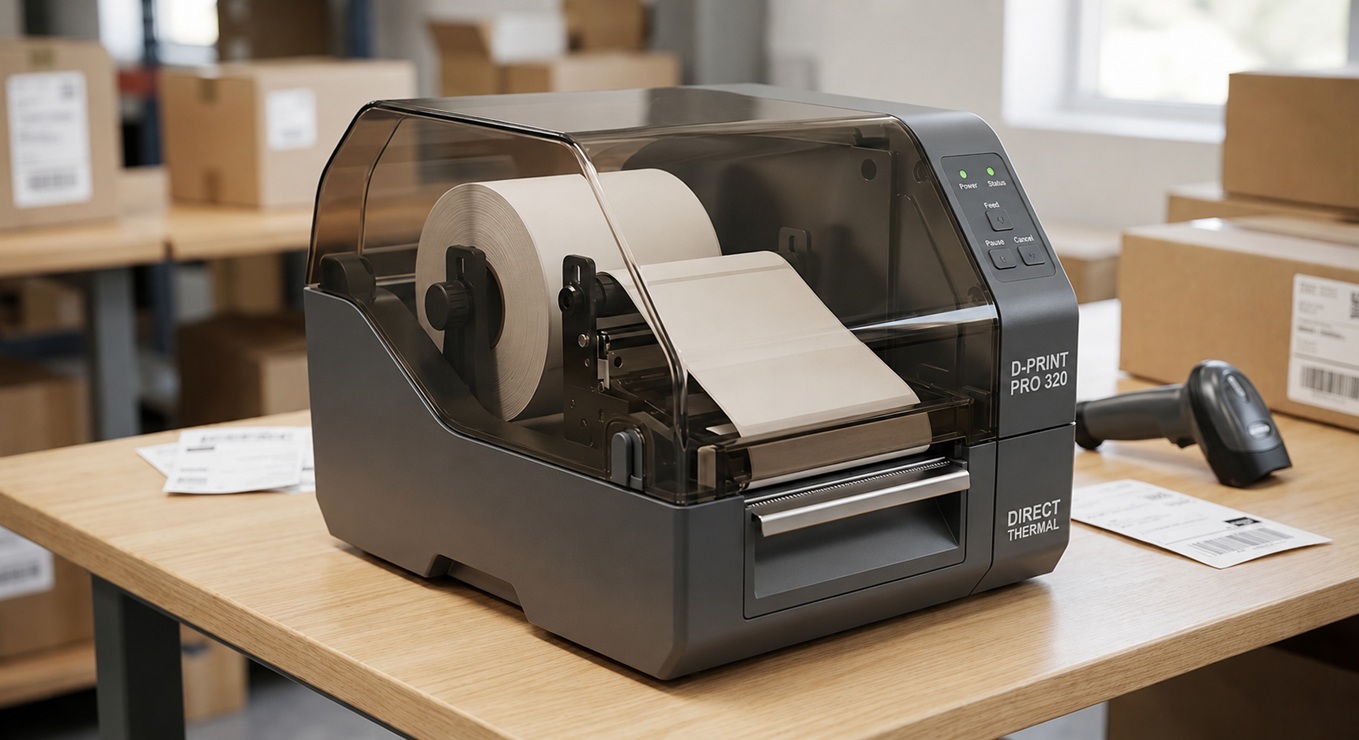
Direct Thermal printers feature a specialized printhead that applies precise heat directly to heat-sensitive paper media. The paper itself contains a chemical topcoat that turns black when exposed to heat. The printer requires only the label roll itself to produce high-resolution barcodes, text, and graphics.
Part 3: Key Benefits of Direct Thermal Label Printers
1. Zero Cost for Ink, Toner, or Ribbons
The primary advantage of direct thermal technology is the elimination of printing consumables. You will never need to purchase ink cartridges, laser toners, or carbon ribbons again. Your only ongoing material cost is the thermal paper labels, which significantly lowers your total cost per print.
2. Operational Simplicity and High Reliability
Because direct thermal printers do not use ribbons or ink mechanisms, their internal design is straightforward. Fewer moving parts mean fewer mechanical failures. Additionally, your team will save time by only needing to reload label rolls rather than managing tangled carbon ribbons or depleted ink cartridges.
3. Rapid Print Speeds for High-Volume Workflows
Direct thermal printers are engineered for fast operational environments. Industrial and desktop models can print at speeds ranging from 4 to 10+ inches per second (ips). This allows shipping tags, receipts, and inventory barcodes to print instantly, keeping packing stations and production lines moving efficiently.
4. Compact and Durable Hardware Footprint
Without the need to house ink mechanisms or ribbon spindles, direct thermal printers feature a compact design. They occupy minimal space on packing desks, retail counters, or mobile carts, making them ideal for space-constrained environments.
Part 4: Common Applications and Ideal Use Cases
Direct thermal printing is highly effective for high-volume, high-velocity labeling applications where labels are used for short-to-medium-term tracking.
|
Industry Sector |
Common Practical Applications |
Why Direct Thermal Excites Users |
|
Logistics & E-Commerce |
Shipping labels (4x6), courier tags, receiving stickers |
High-speed printing, clear barcodes, instantly scannable by couriers. |
|
Retail & Point of Sale |
Price tags, shelf-edge labels, markdown stickers, receipts |
Small footprint, on-demand printing directly at checkout or on the floor. |
|
Warehousing |
Pallet breakdown labels, inventory bin tags, product routing |
Easily integrated with inventory management software and barcode scanners. |
|
Healthcare & Food Industry |
Patient wristbands, prescription tags, specimen tubes, date coding |
Clear legibility with no risk of running out of ink mid-shift. |
Part 5: Is Direct Thermal the Right Fit for You?
While direct thermal printing offers significant advantages, it is important to match the technology with your specific application environment. Because thermal paper is heat-sensitive, long-term exposure to direct sunlight, high heat, or harsh chemical solvents can cause the paper to darken or fade over time.
When to Choose Direct Thermal:
- Your labels are primarily used for short-to-medium-term tracking (such as shipping labels, retail tags, or food rotation labels).
- The labeled products are stored indoors and kept away from extreme environmental conditions.
- Your priority is achieving the lowest possible cost per label with minimal maintenance.
If your application requires labels that must endure years of outdoor exposure, chemical washing, or freezing temperatures, a thermal transfer system may be more appropriate. However, for the majority of daily logistics, retail, and organizational tasks, direct thermal offers the most efficient and cost-effective solution.
Summary: Streamline Your Operations Today
Transitioning to a dedicated direct thermal label printer helps eliminate the high costs, maintenance requirements, and waste associated with traditional office printers. By removing ink and ribbons from your workflow, you can lower operational expenses, reduce equipment downtime, and improve overall business efficiency.