What Is Silicone Release Coating? Why Every Label Liner Needs It
What Is Silicone Release Coating?
If you've ever peeled a barcode label, shipping label, or product sticker from its backing paper, you've already experienced silicone release coating-even if you didn't know it.
Silicone release coating is a very thin layer of silicone applied to the surface of the release liner (also called the backing paper). Its job is simple but essential:
It allows the label to peel away smoothly while keeping the adhesive protected until the label is used.
Without this coating, the adhesive would permanently stick to the liner, making labels almost impossible to remove.
Where Is Silicone Release Coating Located?
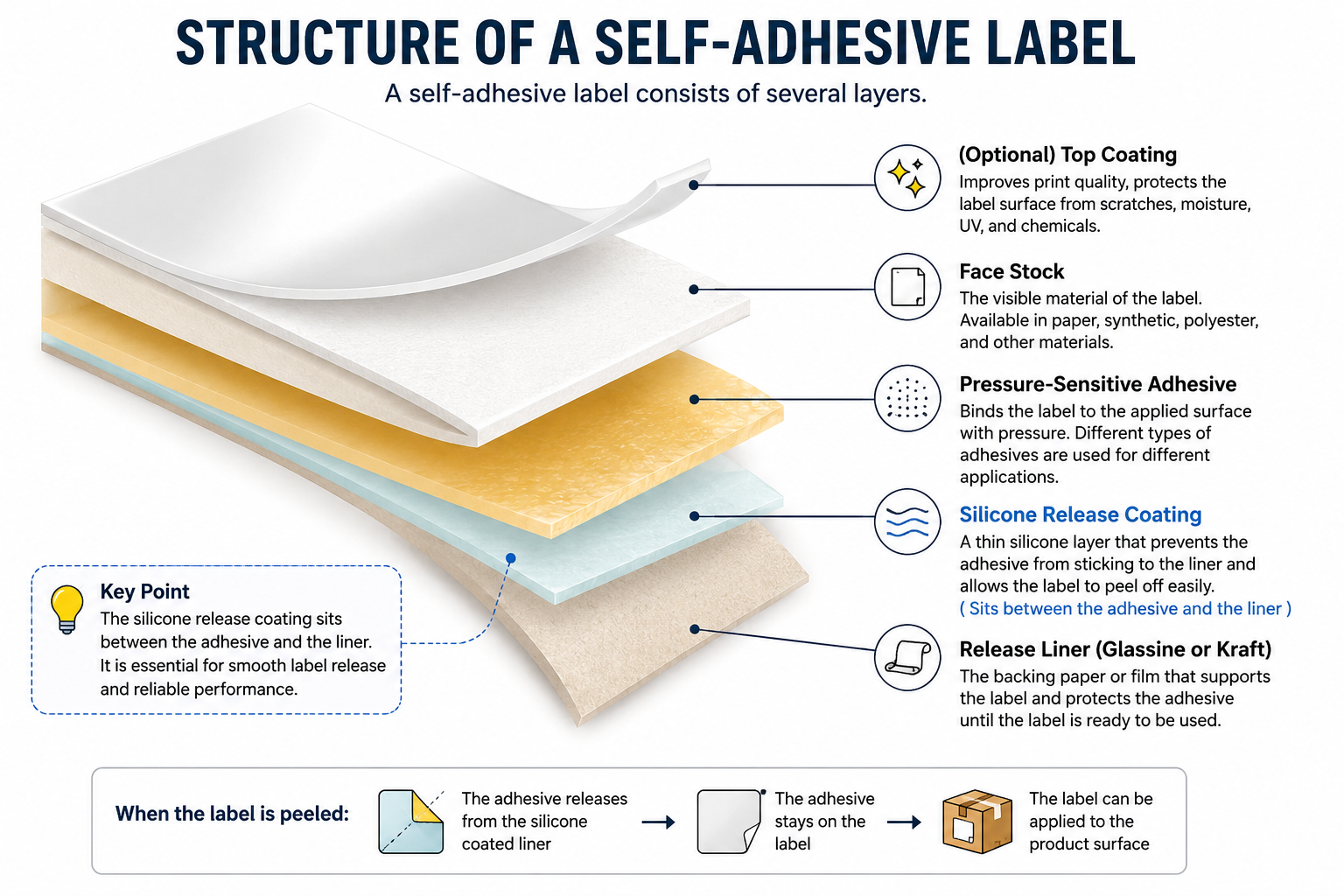
A self-adhesive label consists of several layers.
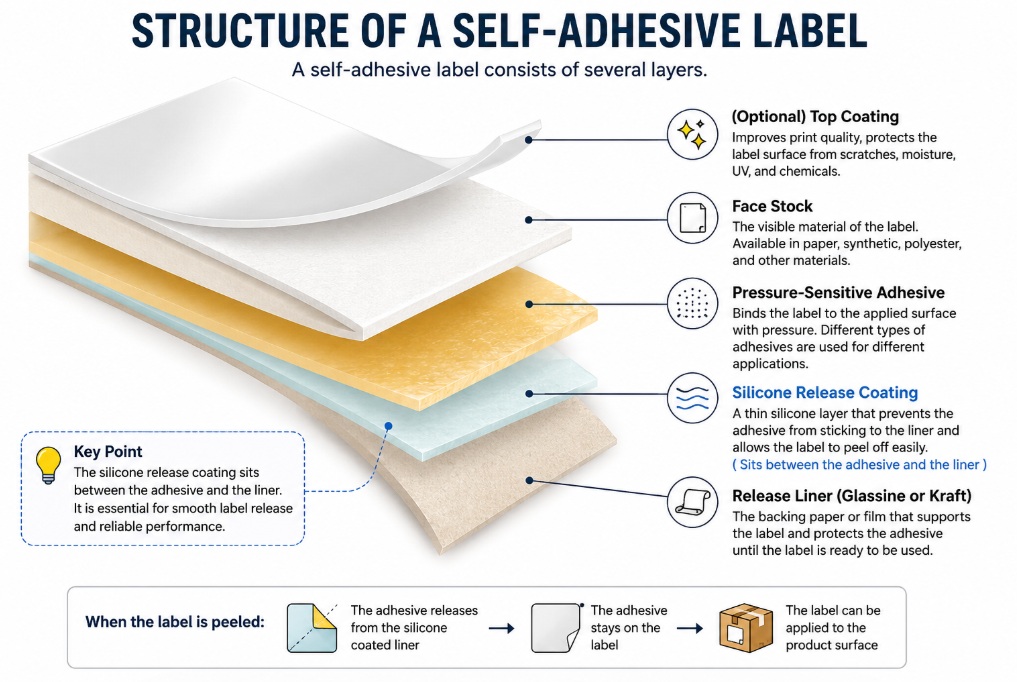
The silicone coating sits between the adhesive and the liner.
Although it is only a few microns thick, it has a huge impact on how labels perform.
Why Is Silicone Applied to the Liner?
Imagine placing strong glue directly onto ordinary paper.
When you try to peel it off:
- The paper tears.
- The adhesive sticks permanently.
- The label becomes unusable.
Silicone solves this problem by creating a low surface-energy layer.
This allows the adhesive to stick firmly to products while releasing easily from the liner.
How Does Silicone Release Coating Work?
Silicone has extremely low surface energy.
This means pressure-sensitive adhesives cannot bond permanently to it.
When you peel a label:
- The adhesive releases from the silicone-coated liner.
- The adhesive remains on the label.
- The liner stays intact.
- The label can be applied immediately.
Without silicone, labels would either tear, curl, or lose adhesive during removal.
Why Is Silicone Important?
Silicone release coating is one of the most important components in label manufacturing because it enables reliable dispensing and application.
Its benefits include:
- Smooth label peeling
- Protects adhesive until use
- Prevents adhesive contamination
- Reduces tearing of the liner
- Supports automatic label dispensing
- Improves printer reliability
- Increases manufacturing consistency
- Extends label shelf life
Although users rarely see it, silicone coating is critical to every pressure-sensitive label.
Advantages of Silicone Release Coating
1. Easy Label Removal
Labels peel away cleanly with minimal effort.
This improves efficiency in:
- Warehouses
- Retail stores
- Manufacturing
- Shipping departments
2. Protects the Adhesive
The adhesive remains clean until the label is applied.
Without the liner and silicone coating, dust and dirt would quickly contaminate the adhesive.
3. Prevents Liner Damage
Silicone prevents:
- Paper tearing
- Fibre transfer
- Adhesive sticking permanently
- Uneven peeling
4. Supports Automatic Label Printers
Desktop and industrial label printers rely on labels separating smoothly from the liner.
A poorly coated liner may cause:
- Label jams
- Wrinkling
- Dispensing failures
- Calibration problems
5. Improves Production Speed
Label converters produce thousands of labels every minute.
Consistent silicone coating ensures:
- Stable die-cutting
- Smooth rewinding
- Reliable dispensing
- Consistent quality
Types of Silicone Release Coating
Single-Sided Silicone
The most common type.
Silicone is applied only to the side that contacts the adhesive.
Used in:
- Barcode labels
- Shipping labels
- Retail labels
- Product stickers
Double-Sided Silicone
Silicone is applied to both sides of the liner.
Used when:
- Rolls are wound tightly
- Labels require smooth unwinding
- High-speed converting processes are used
Differential Silicone Release
One side has a stronger release than the other.
This controls:
- Roll winding
- Label dispensing
- Automatic application
Common in industrial label production.
Common Liner Materials
Silicone can be applied to several liner types.
|
Liner Material |
Common Applications |
|
Glassine |
Barcode labels |
|
Super Calendered Kraft (SCK) |
Industrial labels |
|
Clay Coated Kraft (CCK) |
Heavy-duty labels |
|
PET Film |
High-performance labels |
Each liner uses silicone to provide controlled release.
What Happens Without Silicone?
Without silicone release coating:
- Labels would permanently stick to the liner.
- The adhesive would tear away.
- The liner would rip.
- Automatic label applicators would fail.
- Barcode printers would struggle to dispense labels correctly.
- Production costs would increase significantly.
In short, pressure-sensitive labels would not function as intended.
Silicone Release vs Adhesive
These two layers serve completely different purposes.
|
Silicone Release Coating |
Adhesive |
|
Applied to the liner |
Applied to the label |
|
Allows easy release |
Bonds the label to the product |
|
Low surface energy |
High bonding strength |
|
Temporary contact |
Permanent or removable bond |
They work together to ensure the label peels away cleanly while still adhering securely to the final surface.
Industries That Depend on Silicone Release Coating
Nearly every pressure-sensitive label uses silicone-coated liners, including:
- Retail
- Warehousing
- Logistics
- Manufacturing
- Healthcare
- Food packaging
- Electronics
- Pharmaceuticals
- Automotive
- Asset tracking
Frequently Asked Questions
Is silicone release coating visible?
Usually not. It is an extremely thin transparent coating.
Does silicone make the adhesive weaker?
No. The silicone only allows the label to release from the liner. Once applied to a product, the adhesive performs as designed.
Is every label liner coated with silicone?
Most pressure-sensitive label liners are silicone coated. The exact formulation depends on the label application and converting process.
Can barcode printers work without silicone-coated liners?
Not reliably. The silicone coating helps labels separate cleanly from the liner, supporting smooth feeding and dispensing.
Conclusion
Silicone release coating is one of the hidden technologies that make modern self-adhesive labels possible. Applied to the liner, this ultra-thin coating prevents the adhesive from bonding permanently to the backing paper while allowing labels to peel away smoothly when needed.
Whether you're printing barcode labels, shipping labels, product stickers, or industrial identification labels, silicone release coating ensures reliable dispensing, protects the adhesive, and supports efficient manufacturing and printing. Although invisible to most users, it is an essential component of every high-quality pressure-sensitive label.
Continue gaining knowledge