A Comprehensive Guide to the 42mm × 16mm Impinj M830 UHF RFID Label
Introduction: The Shift Toward Compact, High-Performance RFID
In modern asset management, retail inventory control, and high-speed supply chain logistics, efficiency and footprint optimization are critical. As businesses scale operations, the demand shifts toward smaller, highly reliable labels that can fit onto narrow packaging, pharmaceutical cartons, cosmetics, and compact retail hangtags without sacrificing read range or reliability.
Enter the 50mm × 30mm UHF RFID Label housing a precision-engineered 42mm × 16mm inlay powered by the next-generation Impinj M830 chip. Combining a compact rectangular form factor, state-of-the-art silicon architecture, and superior RF sensitivity, this label has become a premier choice for high-density item-level tagging.
This comprehensive tutorial and reference guide explores everything you need to know about this high-performance label, covering its physical structure, technical architecture, Impinj M800-series capabilities, step-by-step encoding workflows, and practical industry deployment strategies.
1. Anatomy of a Compact 50mm × 30mm UHF RFID Label
Understanding the physical construction of a compact smart label helps ensure successful print-and-apply operations. This label consists of three primary functional strata:
- The Face Stock (Substrate): Typically constructed from high-grade thermal transfer coated paper or white PET film. Measuring precisely 50mm × 30mm, it provides an unblemished print surface for variable data, high-resolution barcodes, human-readable SKU text, and company branding.
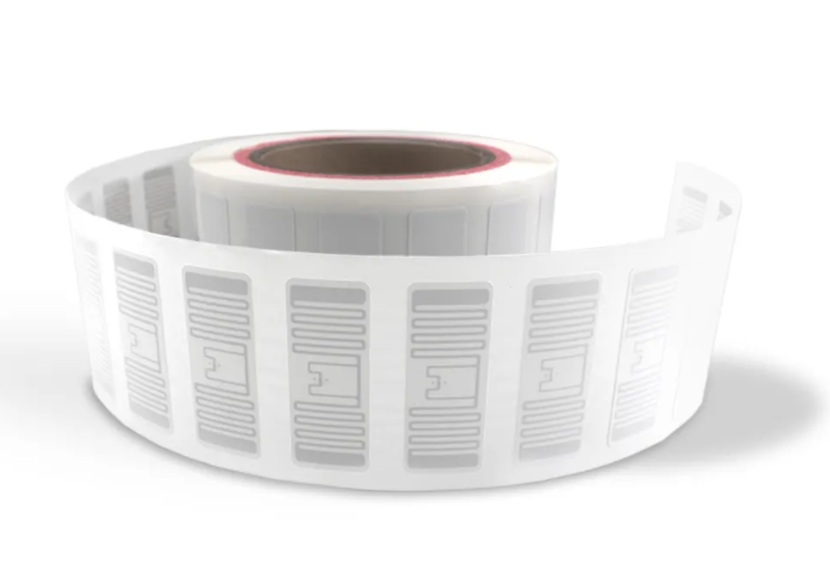
- The RFID Inlay (Antenna + M830 IC): Centered beneath the face stock, the compact 42mm × 16mm etched aluminum or copper antenna is directly coupled to the Impinj M830 integrated circuit via robust bonding pads. This antenna geometry is specifically optimized for small-form-factor tracking while maintaining maximum backscatter efficiency.
- The Adhesive and Release Liner: Backed with a permanent, high-tack acrylic adhesive protected by a silicone release liner, ensuring strong bonding performance across curved or flat surfaces like corrugated cardboard, plastic packaging, and glass containers.
2. Key Specifications and Technical Architecture
The 50mm × 50mm format's smaller sibling - the 50mm × 30mm label with a 42mm × 16mm M830 inlay - is engineered to meet rigorous industrial and retail demands:
Physical & Environmental Parameters
- Outer Label Dimensions: 50mm width × 30mm height (providing a clean layout with structural margins around the internal inlay to safeguard the microchip during thermal printing).
- RFID Inlay Size: 42mm × 16mm, compact layout designed to fit slim packaging.
- Face Material: High-grade coated thermal transfer paper.
- Operating Frequency: Global UHF 860-960 MHz, complying with both North American (FCC 902-928 MHz) and European (ETSI 865-867.6 MHz) bands.
- Operating Temperature: -
 to
 (
 to
 ).
Chip and Performance Parameters (Impinj M830)
- IC Chip: Impinj M830 (Impinj M800 Series)
- Air Interface Protocol: ISO/IEC 18000-63 (Type C) and EPCglobal Gen2v2
- EPC Memory: 128-bit
- TID Memory: 96-bit with a unique 48-bit factory-programmed serialization
- User Memory: 0 bits (optimized for fast, ultra-efficient identifier-based tracking workflows and serialized EPC deployments)
- Read/Write Sensitivity: Industry-leading read sensitivity (up to
 with a dipole) and write sensitivity (
 ), enabled by Impinj Power Boost technology.
3. Why the Impinj M830 Chip Redefines Small Labels
The core advantage of this label lies in the Impinj M830 silicon architecture. While older chip generations struggled with read range when miniaturized into small inlays, the M800 series introduces breakthrough capabilities:
- AutoTune™ Technology: The M830 chip features an integrated AutoTune block that automatically adjusts the chip’s input capacitance at power-up. This widens the tuning dynamic range across the entire 860–960 MHz spectrum, ensuring that even a compact 42mm × 16mm antenna maintains peak resonance and optimal power harvesting.
- TagFocus™ Mode: This feature allows readers to temporarily silence already-inventoried tags by refreshing their state persistence. It eliminates redundant reads in dense inventory environments, enabling readers to instantly focus on outlier or weak tags that are typically the hardest to capture.
- Gen2X Support & Enhanced Readability: Provides advanced waveform optimizations, boosting reader-to-tag communications and speeding up multi-tag inventory rounds.
4. Step-by-Step Implementation and Deployment Tutorial
Deploying a 50mm × 30mm UHF RFID label requires precise printer setup and placement protocols. Follow this workflow for seamless integration:
Step 1: Surface Preparation and Placement
- Substrate Compatibility: Best suited for non-metallic surfaces, including secondary packaging, pharmaceutical boxes, poly bags, and corrugated trays. Avoid direct application to bare metals unless an on-metal spacer layer is used.
- Placement Positioning: Align the label consistently on products so that reader antennas encounter the 42mm × 16mm internal dipole uniformly across the conveyor or check-point.
Step 2: Thermal Transfer Printer Calibration
- Printer Readiness: Use an industrial or desktop thermal transfer printer equipped with a UHF RFID encoding module (compatible with Zebra, SATO, or Printronix units).
- Media Pitch & Power Tuning: Set the label pitch to 30mm. Calibrate the RFID encoder power carefully; because the M830 features high sensitivity, lower write power is often sufficient, protecting the 42mm inlay from over-energization while securing the 128-bit EPC write sequence. Simultaneously, align the printhead heat settings to ensure crisp text and barcode output on the 50mm × 30mm face stock.
Step 3: Validation and Testing
- Pilot Run: Execute a controlled test pass through your read stations or handheld scanners. Verify that the 128-bit EPC reads instantly, confirming that the AutoTune feature has optimized the tag's frequency response inside your operational environment.
5. Ideal Industry Applications
- Pharmaceutical & Healthcare: Tagging medication cartons, vaccine packaging, and specimen tubes where space is tight but unique item tracking is legally or operationally mandated.
- Retail Apparel & Accessories: Labeling small hanging tags, jewelry boxes, cosmetics, and eyewear packaging for rapid stock audits and point-of-sale checkouts.
- Logistics & Document Management: Tracking file folders, mail trays, and component boxes where larger labels cannot physically fit.
6. Summary of Operational Benefits
|
Feature |
Operational Advantage |
|
Compact Form Factor (50×30mm) |
Fits neatly on small consumer goods, slim packaging, and narrow retail items. |
|
Impinj M830 Silicon |
Delivers superior read sensitivity (-25.5 dBm) despite the compact 42×16mm antenna size. |
|
AutoTune™ Adaptability |
Automatically optimizes chip capacitance for global frequency compliance (860-960 MHz). |
|
TagFocus™ Efficiency |
Silences redundant reads on high-speed lines to capture elusive or shielded tags. |
Conclusion
The 50mm × 30mm Impinj M830 UHF RFID Label (42mm × 16mm Inlay) bridges the gap between miniaturization and enterprise-grade performance. By leveraging advanced features like AutoTune and superior read sensitivity, businesses can achieve flawless item-level traceability even within confined packaging constraints.