What Is Label Face Stock Thickness
What Is Label Face Stock Thickness (GSM)?
When purchasing barcode labels, many buyers focus on the label size, adhesive, or printer compatibility. However, one of the most important specifications affecting print quality and durability is the face stock thickness, commonly expressed as GSM (grams per square metre).
Although two label rolls may look identical, the paper used to manufacture them can vary significantly in weight, stiffness, and quality. These differences affect not only the appearance of the label but also how well it feeds through the printer, how durable it is during handling, and how long the printed barcode remains readable.
Choosing the correct face stock thickness is just as important as selecting the correct adhesive or ribbon.
What Does GSM Mean?
GSM (Grams per Square Metre) is a measurement of the weight of the label material.
It represents how much one square metre of paper weighs.
For example:
- 70 GSM means one square metre of paper weighs 70 grams.
- 80 GSM means one square metre weighs 80 grams.
- 100 GSM means one square metre weighs 100 grams.
In general, a higher GSM indicates a heavier and usually thicker paper.
However, GSM measures weight, not actual thickness. Two papers with the same GSM may have different thicknesses depending on the type of fibres, coatings, and manufacturing process used.
Face Stock vs Total Label Construction
Many users assume the GSM refers to the complete label.
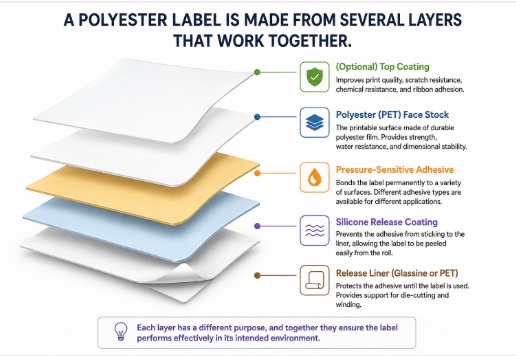
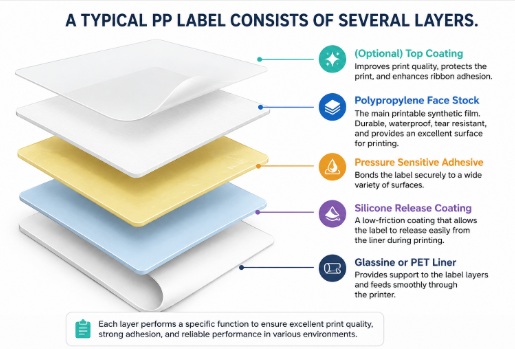
In reality, a barcode label consists of several layers:
- Face stock (the printable material)
- Adhesive
- Silicone release coating
- Release liner (backing paper)
When a manufacturer specifies 80 GSM, this usually refers only to the printable face stock and not the total thickness of the finished label.
Why Face Stock Thickness Matters
The face stock influences several important characteristics of a barcode label, including:
- Print quality
- Tear resistance
- Durability
- Rigidity
- Feeding consistency
- Application performance
- Overall product appearance
A well-balanced face stock provides excellent print quality while remaining flexible enough to apply smoothly to the intended surface.
Recommended Face Stock Thickness by Label Type
There is no single GSM suitable for every application. The ideal face stock depends on the intended use, the printing method, and the environment.
Standard Barcode Paper Labels (80–90 GSM)
Best for:
- Shipping labels
- Warehouse labels
- Inventory labels
- Product identification
- Retail barcodes
- Logistics labels
This is the most common face stock used for Direct Thermal and Thermal Transfer barcode labels.
Advantages include:
- Excellent print quality
- Reliable printer feeding
- Good tear resistance
- Consistent barcode scanning
- Cost-effective production
For most barcode applications, 80 GSM premium paper provides the best balance between quality, durability, and cost.
Premium Paper Labels (100–160 GSM)
Premium paper labels provide a thicker, more rigid, and higher-quality appearance than standard barcode labels.
These materials are commonly used for:
- Luxury retail packaging
- Wine and spirit bottles
- Gourmet food products
- Cosmetic packaging
- Premium gift boxes
- High-end branding labels
The increased paper weight gives the label a more substantial feel while improving resistance to bending and handling.
Premium face stock also performs well with decorative finishing techniques such as:
- Embossing
- Debossing
- Foil stamping
- Spot UV coating
- Textured finishes
These processes are difficult to achieve on lightweight thermal paper.
However, heavier paper is generally not recommended for standard thermal barcode printing, as most desktop and industrial barcode printers are designed for media in the 75–90 GSM range.
Synthetic Labels (PP, BOPP, PE & Vinyl)
Plastic film labels are generally specified by microns (µm) or mils rather than GSM.
Typical thicknesses range from:
- 50–75 microns
- 2–3.5 mil
They are ideal for:
- Cosmetic bottles
- Beverage containers
- Outdoor products
- Freezer storage
- Waterproof applications
- Refrigerated products
Although these materials often have a lower GSM than paper, they are significantly stronger due to their plastic construction.
Polyester (PET) Labels
Polyester labels are designed for demanding industrial environments.
Typical thickness ranges from:
- 50–125 microns
Common applications include:
- Asset tags
- Electrical equipment
- Rating plates
- Chemical labels
- Industrial machinery
- Outdoor equipment
PET labels offer excellent resistance to:
- Heat
- Chemicals
- Moisture
- UV exposure
- Abrasion
These materials are normally printed using Resin Thermal Transfer Ribbons.
Is Thicker Always Better?
No.
Many buyers assume that a thicker paper automatically means a better label.
In reality, manufacturing quality is far more important than GSM alone.
A premium 80 GSM face stock with:
- Smooth printable surface
- Consistent coating
- Accurate die-cutting
- High-quality adhesive
- Stable release liner
will usually outperform a poorly manufactured 100 GSM label.
Quality should always be evaluated as the complete label construction-not simply the paper weight.
Why Very Thin Labels Are Not Recommended
Some low-cost labels use thinner face stock to reduce manufacturing costs.
Although they may appear similar, thinner materials can introduce several disadvantages.
Reduced Print Quality
Thin paper often absorbs thermal energy less consistently, resulting in:
- Lighter printing
- Uneven image density
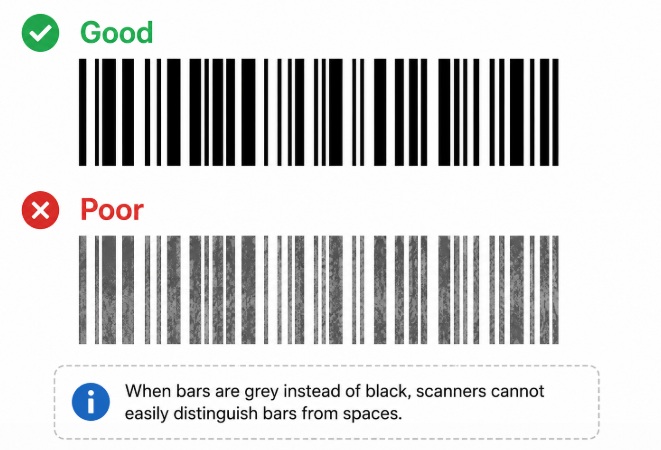
- Reduced barcode contrast
Premium face stock provides a smoother, more uniform printing surface.
Lower Tear Resistance
Thin labels are more likely to tear during:
- Manual handling
- Shipping
- Automatic application
- Product use
This can reduce barcode readability and product presentation.
Increased Curling
Lightweight papers are generally more sensitive to:
- Heat
- Humidity
- Environmental changes
This may cause labels to curl or lift after application.
Less Rigidity
A stiffer label feeds more consistently through barcode printers.
Very thin face stock may flex more during printing, particularly at higher print speeds.
Although the release liner provides most of the structural support, the face stock also contributes to stable media feeding.
Choosing the Right Face Stock
Selecting the correct material involves more than simply choosing the highest GSM.
Consider the following:
Application
Will the label be used for:
- Shipping
- Warehousing
- Retail
- Healthcare
- Manufacturing
- Asset tracking
Printing Technology
Choose a material compatible with:
- Direct Thermal printing
- Thermal Transfer printing
Environment
Consider whether the label will be exposed to:
- Indoor conditions
- Outdoor weather
- Refrigeration
- Freezers
- Chemicals
- Moisture
- UV light
Surface Shape
If the label will be applied to:
- Small bottles
- Curved containers
- Cylindrical products
- Flexible packaging
choose a thinner or more flexible material.
Very thick paper can lift around curved surfaces, a condition known as flagging.
Printer Compatibility
Always ensure the complete media construction falls within your printer manufacturer's recommended specifications.
Media that is excessively thick may increase:
- Printhead pressure
- Feeding resistance
- Mechanical wear
Recommended Materials by Application
|
Application |
Recommended Material |
|
Shipping Labels |
80 GSM Paper |
|
Warehouse Labels |
80 GSM Paper |
|
Retail Product Labels |
80–90 GSM Paper |
|
Luxury Packaging |
100–160 GSM Premium Paper |
|
Cosmetic Products |
PP or BOPP Film |
|
Freezer Labels |
PP Synthetic |
|
Outdoor Labels |
PET |
|
Chemical Labels |
PET |
|
Asset Tags |
PET |
Best Practices
When selecting barcode labels:
✔ Choose labels from reputable manufacturers.
✔ Select the correct material for the application.
✔ Focus on manufacturing consistency rather than GSM alone.
✔ Ensure accurate die-cutting and gap spacing.
✔ Verify adhesive suitability.
✔ Confirm printer compatibility.
✔ Don't sacrifice quality simply to reduce cost.
Frequently Asked Questions
What is the best GSM for barcode labels?
For most Direct Thermal and Thermal Transfer barcode labels, 80–90 GSM provides the ideal balance between durability, print quality, and reliable printer performance.
Does a higher GSM produce better print quality?
Not necessarily.
Smooth coatings, high-quality paper, accurate die-cutting, and consistent manufacturing often have a greater impact on print quality than GSM alone.
Is 70 GSM suitable for barcode labels?
It can be suitable for light-duty applications, but it generally offers lower tear resistance and durability than premium 80 GSM paper.
Should I always choose the thickest label?
No.
The best label is the one that matches the application. For harsh environments, selecting a synthetic material such as PP or PET is usually a better solution than simply increasing the GSM of a paper label.
Conclusion
Face stock thickness is an important factor in barcode label performance, but it should never be considered on its own. For most barcode printing applications, 80–90 GSM premium paper offers the ideal balance between print quality, durability, flexibility, and printer compatibility.
While heavier papers create a more premium appearance for luxury packaging, they are generally unnecessary for standard barcode printing. Likewise, choosing extremely thin paper simply to reduce cost can lead to poorer print quality, reduced durability, and inconsistent feeding.
When evaluating barcode labels, consider the entire label construction-including face stock, adhesive, release liner, die-cut accuracy, and manufacturing consistency. A well-manufactured label with the correct material will always outperform one chosen solely on GSM.
Related Topics :
How Barcode Printers Detect Labels – Gap Sensor vs Black Mark Sensor
What Is a Liner in a Label Roll? Why Liner Thickness Matters